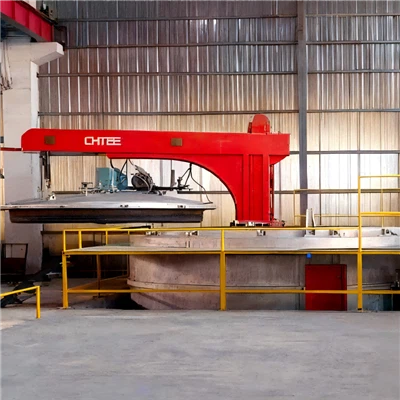
A quenching furnace is a widely used heat treatment equipment in industrial production, playing a crucial role in improving the performance of metal materials. Below, we will provide a detailed explanation of the working principle and application scope of quenching furnaces.

The Working Principle of a Quenching Furnace
The working principle of a quenching furnace is based on the theory of heat treatment of metal materials. Its core objective is to alter the microstructure of metal materials through heating, holding at temperature, and rapid cooling, thereby improving their hardness, strength, wear resistance, and other properties.
1. Heating Stage
When the metal material is placed in the quenching furnace, the heating system begins to operate. There are various heating methods, commonly including resistance heating, gas heating, and induction heating.
* Resistance Heating: Resistance heating utilizes the heat generated by electric current passing through a resistive element, transferring this heat to the metal material. The resistive element is usually made of a high-resistance alloy, such as nickel-chromium alloy. The advantages of this heating method are uniform heating and high temperature control accuracy, making it suitable for applications requiring high heating quality.
* Gas Heating: Gas heating involves burning fuel gas (such as natural gas, coal gas, etc.) to release a large amount of thermal energy, increasing the temperature inside the furnace. Gas heating is characterized by fast heating speed and relatively low cost, but the temperature control accuracy may not be as high as resistance heating.
* Induction Heating: Induction heating utilizes the principle of electromagnetic induction to generate induced current in the metal material, causing the material to heat up through the thermal effect of the current. Induction heating has the advantages of extremely fast heating speed and high efficiency, and is often used in processes requiring high heating speed.
During the heating process, the temperature of the metal material gradually increases, and the activity of the atoms increases. When a certain temperature is reached, the crystal structure of the metal begins to change, transforming from a stable structure at room temperature to an unstable structure at high temperature, preparing it for the subsequent quenching treatment.
2. Soaking Stage
After the metal material reaches the predetermined quenching temperature, it needs to be held at that temperature for a period of time. This process is called soaking. The purpose of soaking is to ensure that the temperature inside the metal material is uniform, guaranteeing that the entire material undergoes a complete transformation of its microstructure. The duration of the soaking time depends on factors such as the type of material, the size and shape of the workpiece. Generally, the poorer the thermal conductivity of the material and the larger the workpiece size, the longer the soaking time required.
3. Cooling Stage
After the holding period, the metal material needs to be rapidly cooled to room temperature, which is a critical step in the quenching process. The cooling rate directly affects the microstructure and properties of the metal material. Commonly used cooling media include water, oil, and brine.
* Water: Water is a commonly used cooling medium with strong cooling capacity, allowing for rapid cooling of the metal material. However, the rapid cooling rate of water may lead to significant internal stress in the workpiece, and even cause defects such as cracks.
* Oil: Oil has a relatively slower cooling rate and is suitable for metal materials that do not require a very high cooling rate. Oil cooling can reduce internal stress in the workpiece and lower the risk of cracking, but the hardness after quenching may be lower than with water cooling.
* Brine: Brine has a cooling capacity between that of water and oil. It can increase the cooling rate to a certain extent while avoiding some of the problems associated with water cooling.
Applications of Quenching Furnaces
Quenching furnaces have a wide range of applications in numerous industrial fields. The following are some of the main application areas:
1. Mechanical Manufacturing Industry
In mechanical manufacturing, many components require quenching treatment to improve their performance. For example, gears are critical components in mechanical transmission, and quenching can improve their hardness and wear resistance, extending their service life. Shaft parts also often use quenching processes to enhance their strength and toughness, ensuring that they do not deform or break under heavy loads. In addition, tools such as cutting tools and molds also rely on quenching furnaces during their manufacturing process; quenching treatment makes cutting tools sharper and more durable, and molds more precise and reliable.
2. Automotive Industry
The automotive industry is one of the important areas of application for quenching furnaces. Key components of automobile engines, such as crankshafts and connecting rods, need to possess high strength and good wear resistance, and quenching treatment can meet these performance requirements. Components of the braking system and suspension system of automobiles also require quenching treatment to improve their safety and reliability. In the production process of automotive parts, the efficient and precise heat treatment capabilities of quenching furnaces provide a strong guarantee for the quality of automobiles.
3. Aerospace Industry
The aerospace field has extremely high demands on material performance, and the application of quenching furnaces in this field is also very important. Components of aircraft engines, such as blades and turbine disks, need to operate in harsh environments of high temperature, high pressure, and high speed, so they must possess excellent high-temperature strength, oxidation resistance, and corrosion resistance. Through heat treatment processes such as quenching, the performance of these components can meet the strict requirements of aerospace engineering. In addition, aircraft structural components and landing gear also require quenching treatment to ensure flight safety.
4. Shipbuilding Industry
Ships face complex working conditions and harsh corrosive environments in the marine environment, so key components of ships need to possess good overall performance. Quenching furnaces are used in the shipbuilding industry for heat treatment of ship propellers, shaft systems, anchor chains, and other components. After quenching treatment, the strength, hardness, and corrosion resistance of these components are significantly improved, enabling them to better adapt to the challenges of the marine environment and extend the service life of the ship.
5. Power Industry
In the power industry, components such as the rotor and stator of generators are subjected to immense electromagnetic forces and mechanical stresses, thus requiring materials with high performance characteristics. Heat treatment of these components in a quenching furnace improves their strength and toughness, ensuring the stable operation of the generators. Furthermore, transmission line towers and fittings also require quenching treatment to enhance their resistance to wind, seismic activity, and corrosion.
Thanks to its unique working principle, the quenching furnace plays a vital role in various industrial fields. It can precisely control the heating, holding, and cooling processes according to different materials and process requirements, imbuing various metal materials with excellent properties and meeting the stringent requirements for material quality and performance in modern industrial production.
CHTEE Industrial Heat Treatment Furnace


ENGINEERED TO ORDER
Our strength is the ability to custom engineer a complete furnace system for any customer requirement.
REQUEST A QUOTE