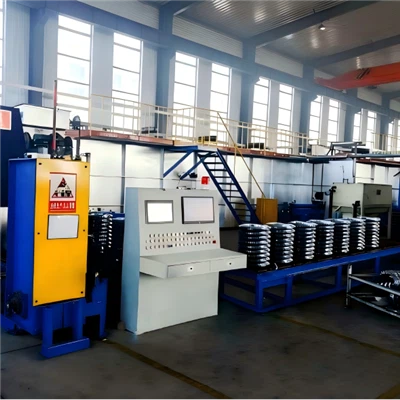

Product Feature
Strong flexibility : Different temperatures, holding times and cooling curves can be set for each batch, which is suitable for multi-variety and small batch production.
The equipment has a simple structure : it does not require a continuous material conveying device, and is relatively easy to maintain and control.
The investment is relatively low (in small batches and complex processes) and is more economical than continuous lines.
Temperature and atmosphere fluctuations : Due to each loading/unloading of the furnace, the furnace temperature and atmosphere conditions have periodic fluctuations.
|
Serial Number |
Model |
Power |
Natural gas |
MHximum charging capacity |
Loading size |
External dimensions |
Crane height |
|
1 |
TE-A-MH-G-240/240 |
45KW |
60m³/H |
16T |
φ2400*H2400 |
φ3900*H3350 |
7500mm |
|
2 |
TE-A-MH-G-280/240 |
65KW |
80m³/H |
24T |
φ2800*H2400 |
φ4300*H3350 |
7500mm |
|
3 |
TE-A-MH-G-320/240 |
65KW |
100m³/H |
28T |
中3200*H2400 |
φ4700*H3350 |
7500mm |
|
4 |
TE-A-MH-G-360/240 |
85KW |
120m³/H |
32T |
φ3600*H2400 |
φ5100*H3350 |
7500mm |
|
5 |
TE-A-MH-G-360/340 |
95KW |
150m³/H |
36T |
φ3600*H3400 |
φ5100*H4350 |
9500mm |
Working Principle Of Batch Annealing Furnace
Loading and sealing:Load metal materials or components into the furnace and seal it to ensure the furnace body is airtight and prevent outside air from entering.
Atmosphere or vacuum preparation:According to the requirements of different materials, vacuum is drawn or protective gas (nitrogen, hydrogen, argon, etc.) is introduced to remove oxygen and moisture and prevent oxidation and decarburization during the heating process.
The heating:Adopts resistance heating or gas heating system, and slowly heats up according to the set temperature curve to make the temperature distribution of the workpiece uniform and reduce thermal stress.
During the insulation stage:The material is kept at a constant temperature for a certain period of time to allow the material to recrystallize or diffuse, eliminate internal stress, and improve the organizational structure.
After the slow cooling:Heating is completed, the furnace temperature is gradually reduced according to the set curve, and it can be cooled in an inert atmosphere to prevent discoloration or contamination of the metal surface.
Back pressure and out of the furnace:When the furnace temperature drops to a safe range, slowly restore to normal pressure, open the furnace door and take out the workpiece, completing a complete annealing cycle.
Application Industry
Metallurgy and steel industry
used for stress relief and structural improvement of carbon steel, stainless steel, silicon steel and other materials
Non-ferrous metal processing
heat treatment of copper strips, copper tubes, bronze parts, aluminum plates and other metals
Precision machinery
annealing of sleeves, bushings, springs, gears and other parts
Electronics and electrical industry
annealing treatment of conductor materials, contacts and precision electronic components.
Customized According To Industry Needs
● Furnace size and structure (vertical, horizontal, well type);
● Heating method (resistance, gas, induction) and power level;
● Vacuum system or protective atmosphere system configuration;
● Automatic control system (temperature curve program control, data recording);
● Energy recovery and energy-saving design solutions;
● Discharging and loading methods (manual or robotic automation).

FAQ
1.What configurations can batch annealing equipment be customized for?
This type of heat treatment equipment can typically be designed as a vertical annealing furnace, horizontal annealing furnace, or pit annealing furnace, depending on production requirements. Customers can select the most suitable furnace type based on workpiece size, loading method, and process characteristics to improve temperature uniformity and production efficiency.
2. How do these furnaces prevent metal surface oxidation?
The equipment is equipped with a protective atmosphere system , such as nitrogen, argon, or hydrogen, which forms an insulating layer during the heating and cooling processes, preventing oxygen from entering. This effectively prevents surface discoloration, decarburization, and oxidation, preserving the material's original luster and performance.
3. What materials are suitable for this batch heat treatment furnace? It is
widely applicable to carbon steel, stainless steel, copper and copper alloys, aluminum alloys, and other materials. It is particularly effective for thin strip, precision parts, and conductive components, improving ductility, toughness, and internal stress distribution, thereby enhancing overall quality.
4. How does the cooling method affect workpiece performance?
Cooling rate is directly related to material microstructure and mechanical properties. Slow cooling helps reduce stress and deformation, resulting in grain refinement; while excessively rapid cooling can lead to hardness changes or localized stress concentrations. Therefore, high-end batch heat treatment furnaces are often equipped with programmable control systems that precisely adjust the cooling curve to meet diverse process requirements.
Hot Tags: spray annealing furnace, China spray annealing furnace manufacturers, suppliers, factory, bell furnace, bell type annealing furnace, Bell Type Furnace, Spray annealing furnace