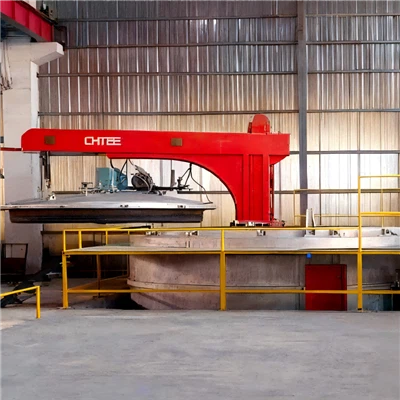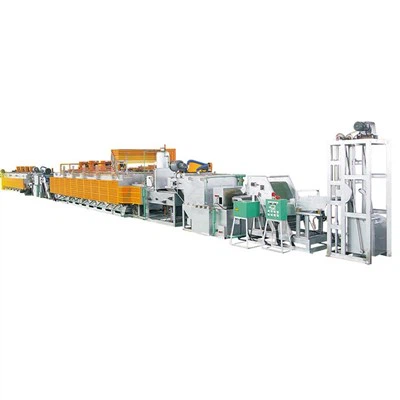
A quenching furnace is used to heat metal components to a controlled temperature before rapidly cooling them in a suitable quenching medium. The process changes the material's microstructure and is widely used to increase hardness, strength, wear resistance, and other required mechanical properties.
In industrial heat treatment, quenching is rarely an isolated process. Depending on the material and application, it may be combined with carburizing, hardening, tempering, annealing, or other thermal processes. The furnace configuration therefore needs to match the workpiece, production volume, required hardness, cooling method, and overall heat treatment route.
CHTEE provides industrial quenching furnace solutions for different production requirements, including continuous mesh belt systems, vacuum quenching equipment, and customized heat treatment lines.
What Is a Quenching Furnace?
A quenching furnace is industrial heat treatment equipment designed to heat metal parts to the required austenitizing or hardening temperature and then transfer them to a controlled cooling stage.
The basic process can be described as:
Loading → Heating → Soaking → Quenching → Tempering
The heating stage brings the workpiece to the required temperature. During soaking, the material remains at temperature long enough for the required transformation conditions to be established. The part is then rapidly cooled in a quenching medium such as oil, water, polymer solution, or another process-specific medium.
The quenching stage is critical because the cooling rate affects the final microstructure and hardness of the component.
For some applications, the furnace line also integrates carburizing before quenching. In this configuration, the process becomes:
Heating → Carburizing → Diffusion → Quenching → Cleaning → Tempering
CHTEE's continuous carburizing and quenching system combines heating, carburizing, quenching, and tempering in one production line.

What Is Quenching Used For in Metal Heat Treatment?
The main purpose of quenching is to obtain a harder and stronger material structure after heating.
Depending on the material and process, industrial quenching can be used to:
- Increase surface or overall hardness
- Improve wear resistance
- Improve mechanical strength
- Obtain a required metallurgical structure
- Prepare components for subsequent tempering
- Support carburizing and case-hardening processes
- Meet specified hardness and mechanical-property requirements
Quenching is particularly important for components exposed to repeated loads, friction, impact, or contact stress.
The required result depends on the steel grade, heating temperature, holding time, cooling rate, quenching medium, component geometry, and subsequent tempering process.
Which Parts Are Commonly Processed in a Quenching Furnace?
The application range of an industrial quenching furnace is broad. The most suitable furnace depends on the size, shape, material, production volume, and required process.
Bolts, nuts, screws, and other fasteners are common applications for continuous quenching systems.
For high-volume fastener production, a mesh belt furnace can continuously transport parts through heating, carburizing, quenching, and tempering stages.
CHTEE's fastener heat treatment solutions use continuous mesh belt atmosphere systems for high-volume production of ferrous and non-ferrous fasteners.
Heat Treatment Solutions for Fasteners can therefore be used as a relevant industry reference when evaluating quenching equipment for bolts, nuts, screws, and similar components.
Automotive parts such as gears, shafts, bolts, nuts, springs, suspension components, bearings, and smaller transmission components can require quenching or carburizing and quenching.
For small and medium-sized automotive parts requiring continuous production, mesh belt quenching equipment can be integrated with washing and tempering sections. CHTEE's automotive heat treatment application page specifically identifies continuous quenching for bolts, nuts, small gears, and bearing components.
Automotive Heat Treatment Solutions provide another relevant internal pathway for buyers searching specifically for automotive component heat treatment.
Bearing manufacturing involves several different heat treatment processes depending on the component.
Bearing rings may require spheroidizing annealing, hardening, and tempering. Bearing rollers can require carburizing and quenching, while bearing balls may require vacuum hardening and vacuum quenching.
CHTEE's bearing application information recommends continuous carburizing and quenching for suitable bearing rollers and vacuum quenching for precision bearing components.
This makes Bearing Heat Treatment Furnace Solutions a useful internal resource when the target application is bearing manufacturing.
Transmission gears, shafts, and related components may require hardening or carburizing and quenching to obtain the required surface hardness and wear resistance.
CHTEE offers a dedicated Belt Type Quenching Furnace for Transmission Parts for this type of application.
Springs, small mechanical parts, stamping components, and other hardware can also be processed in continuous quenching systems when their dimensions and loading characteristics are suitable.
The continuous mesh belt furnace developed by CHTEE is designed for small and medium-sized components and supports quenching, tempering, carburizing, and combined carburizing-quenching-tempering processes.
What Is the Difference Between Quenching and Carburizing?
Quenching and carburizing are related but different heat treatment processes.
Carburizing changes the carbon content of the surface layer of a suitable steel component. It is used when a hard, wear-resistant surface and a tougher core are required.
Quenching rapidly cools the heated component to obtain the required hardened structure.
For a carburized component, the two processes can form part of the same heat treatment route:
Carburizing → Diffusion → Quenching → Tempering
This combination is widely used for components such as gears, fasteners, bearing components, and other parts requiring surface hardening.
CHTEE's continuous mesh belt system is designed around this type of production flow and recommends thin-layer carburizing, particularly for carburized layers below 0.30 mm.
Continuous Type Carburizing Quenching Furnace is therefore the most relevant product page for manufacturers looking for an integrated continuous carburizing and quenching line.
What Are the Main Types of Quenching Furnaces?
Not every quenching application requires the same furnace structure. Production mode and process requirements usually determine the equipment configuration.
A continuous quenching furnace transports parts through the heating and treatment zones using a conveyor or mesh belt.
It is suitable for repetitive production of compatible small and medium-sized components.
Typical applications include:
- Fasteners
- Small gears
- Bearing components
- Springs
- Hardware
- Small mechanical parts
CHTEE's continuous system integrates heating, carburizing, quenching, and tempering into a continuous production line. Its published configurations cover different belt widths and production capacities.
Continuous Type Quenching Furnace is particularly relevant when the production requirement involves continuous material flow.
Vacuum quenching is used when manufacturers need a controlled processing environment with reduced oxidation and contamination.
It is particularly relevant to precision metal parts, tool and die components, stainless steel, titanium alloys, aerospace components, and other applications where surface quality or dimensional control is important.
CHTEE lists vacuum quenching as part of its industrial vacuum heat treatment range.
Vacuum Quenching Furnace can be used as an internal link for readers looking specifically for vacuum hardening and quenching equipment.
Belt-type quenching furnaces are designed around continuous or semi-continuous material handling and are commonly used for suitable fasteners, bearing components, transmission parts, and other small metal components.
CHTEE has separate furnace configurations for bearing components and automotive fasteners.
This type of application-specific equipment can be useful when the production line has a relatively defined part range and continuous output requirement.
Why Is the Quenching Medium Important?
The quenching medium determines how quickly heat is removed from the workpiece.
Common quenching media include:
- Oil
- Water
- Polymer solutions
- Gas
- Other application-specific cooling media
Oil quenching is widely used in industrial heat treatment because it provides a different cooling behavior from water and can be appropriate for many steel components.
CHTEE's continuous mesh belt quenching system uses an oil tank system for the quenching stage.
The selection of the quenching medium should be based on material grade, part geometry, required hardness, distortion tolerance, and the complete heat treatment specification.
Why Are Heating and Cooling Uniformity Important?
A quenching furnace does not simply need to reach a target temperature. It needs to provide repeatable thermal conditions across the workpiece load.
Uneven heating can result in different parts of the same batch receiving different thermal histories. Cooling conditions can also affect hardness distribution, distortion, and the final metallurgical structure.
For continuous production, this becomes even more important because the furnace must maintain stable operating conditions over extended periods.
CHTEE's continuous quenching furnace uses separated heating zones, SCR/PID temperature control, controlled furnace atmosphere, and a mesh belt transmission system designed for stable continuous operation.
Quenching Furnace for High-Volume Production
For high-volume manufacturing, furnace throughput becomes an important equipment selection factor.
A continuous quenching furnace can integrate:
Automatic Loading → Heating → Carburizing → Quenching → Cleaning → Tempering → Unloading
This production flow reduces the need to move parts manually between independent treatment stages.
CHTEE's published continuous furnace configurations have carburizing capacities ranging from 80 kg/h to 1,380 kg/h and tempering capacities from 160 kg/h to 1,600 kg/h, depending on the furnace model.
These figures are equipment-specific rather than universal production rates. Actual output depends on part dimensions, weight, loading density, process cycle, belt speed, carburizing requirements, and other production conditions.
For a new industrial quenching furnace, production capacity should therefore be calculated from the actual workpiece and process rather than selected from a nominal furnace rating.
What Should Be Considered When Selecting a Quenching Furnace?
The right quenching furnace depends on several technical factors.
The steel grade or alloy determines the required heating and cooling conditions.
Part size affects furnace loading, belt selection, heating uniformity, and production capacity.
The target hardness should be defined together with the required metallurgical structure and applicable quality standard.
Low-volume batch production and high-volume continuous production may require completely different furnace configurations.
Oil, water, polymer, gas, or another cooling medium should be selected according to the material and component requirements.
Determine whether the process involves:
- Quenching
- Hardening
- Carburizing and quenching
- Quenching and tempering
- Carburizing, quenching and tempering
- Vacuum hardening
Other combined processes
For high-volume production, PLC control, temperature monitoring, atmosphere monitoring, conveyor control, alarm systems, and production data recording can become important parts of the furnace specification.
CHTEE's continuous system uses PLC and HMI control and supports temperature and atmosphere monitoring, power consumption tracking, historical data storage, production data recording, and alarm visualization.
Quenching Furnace Applications by Industry
The most useful way to evaluate a quenching furnace is often to start with the application rather than the furnace name.
Automotive parts such as gears, shafts, fasteners, springs, and bearings may require carburizing, quenching, hardening, and tempering.
Automotive Heat Treatment Solutions can be linked here because it shows how furnace selection changes according to automotive component type and production requirements.
Fasteners are a strong application for continuous mesh belt quenching because bolts, nuts, and screws can be processed in large quantities when their size and loading conditions are compatible with the conveyor system.
Fastener Heat Treatment Solutions can support this industry-specific keyword cluster.
3.Bearing Heat Treatment
Bearing rings, rollers, balls, and cages require different heat treatment routes. Depending on the component, the process may involve spheroidizing annealing, carburizing, quenching, vacuum hardening, or tempering.
Bearing Heat Treatment Furnace Solutions is suitable for this section.
Steel parts and forged components may require annealing before machining and quenching or hardening after machining or forming.
For broader steel-processing applications, Steel Industry Heat Treatment Solutions can be used as an internal link.
What Makes a Quenching Furnace Suitable for Continuous Production?
A continuous production furnace needs more than a conveyor belt.
The heating zones, atmosphere system, belt transmission, quenching system, tempering section, controls, and safety devices must work as one system.
For example, CHTEE's continuous mesh belt furnace uses independent heating zones, SCR/PID temperature control, a controlled atmosphere system, mesh belt transmission, oil tank quenching, and an integrated tempering section.
The system also includes thermocouple monitoring, mesh belt operation detection, overload protection, abnormal-height detection, and interlock protection.
This type of integrated configuration is more relevant to manufacturers running repetitive high-volume production than to plants processing occasional small batches.
Why Choose CHTEE for Industrial Quenching Equipment?
CHTEE manufactures annealing furnaces, quenching furnaces, vacuum furnaces, carburizing furnaces, and other industrial heat treatment equipment. Its website lists solutions for fasteners, automotive parts, forgings, steel parts, aerospace parts, foundry parts, oil and gas components, and bearings.
The company provides both process-based and equipment-based furnace configurations, allowing buyers to start from either the required heat treatment process or the physical production requirements.
For manufacturers comparing different industrial heat treatment furnace manufacturers, CHTEE provides continuous quenching, mesh belt quenching, vacuum quenching, and customized furnace configurations.
Industrial Heat Treatment Furnace Manufacturer can be used here to connect the article with the company-level manufacturing information.