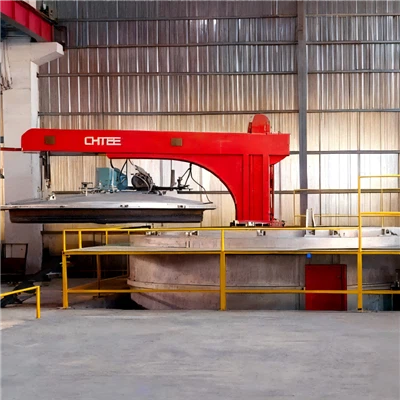

If you have ever seen gears, bearings, chains, fasteners, or automotive parts coming off a production line, chances are they have been through a quenching process. Heat treatment changes the internal structure of steel, giving parts the hardness and wear resistance they need for long-term service.
For manufacturers, getting the right hardness is only part of the job. Every workpiece also needs to be consistent from the first piece to the last. That is why many factories choose a mesh belt furnace for industrial heat treatment. A continuous production process makes temperature, heating time, and quenching conditions much easier to control, helping reduce quality differences between batches.
Why Mesh Belt Furnaces Are Used for Quenching
Traditional batch furnaces work well for small-volume production, but they require repeated loading, unloading, and reheating. Production efficiency is limited, and process consistency depends heavily on the operator.
A continuous heat treatment furnace works differently. Parts move through the furnace on a mesh belt at a fixed speed. Every workpiece follows the same route, stays in each heating zone for the same amount of time, and enters the quenching tank under the same conditions.
This is one reason why industrial mesh belt furnaces are widely used for gears, bearings, bicycle parts, chains, standard fasteners, hand tools, and many other steel components produced in large quantities.
Heating Is More Important Than Most People Think
Many people pay attention to the quenching tank, but the heating stage has an even bigger influence on the final result.
Before steel can be quenched, it must first reach the proper austenitizing temperature. If some parts are heated unevenly, the final hardness may vary even though every part goes through the same cooling process.
A well-designed quenching heat treatment furnace divides the heating chamber into several temperature zones. This allows the workpieces to heat gradually instead of experiencing sudden temperature changes. The result is more uniform heating, lower thermal stress, and better preparation for quenching.
For manufacturers running continuous production, stable heating often means fewer rejected parts and less rework.
Atmosphere Control Protects the Surface
High temperatures create another problem. Steel exposed to air can oxidize or lose carbon during heating.
Oxidation leaves scale on the surface, while decarburization reduces surface hardness. Both increase machining costs and may shorten product life.
Many carburizing quenching furnaces use a controlled protective atmosphere throughout the heating process. Stable atmosphere control helps maintain surface quality and keeps the carbon content where it should be. This is especially important for transmission parts, bearing components, and precision gears where surface performance directly affects service life.
What Happens During Quenching
Once the required temperature has been reached, the workpieces move directly into the quenching section.
The transfer needs to be fast and consistent. If one part cools a few seconds later than another, the metallurgical structure can change. A mesh belt quenching furnace keeps the transfer time the same for every workpiece by matching conveyor speed with the quenching system.
Oil is commonly used as the quenching medium because it provides controlled cooling while reducing the risk of cracking and excessive distortion. Depending on the material and product requirements, other quenching media may also be selected.
After cooling, the steel transforms into a harder structure, giving the component the mechanical properties required for its application.
Why Many Production Lines Combine Carburizing and Quenching
Some components need more than overall hardness. Gears, sprockets, shafts, and bearing races often require a hard outer layer while keeping a tougher core.
This is where a continuous type carburizing quenching furnace becomes the preferred solution.
During carburizing, carbon diffuses into the surface of the steel. The following quenching process hardens this carbon-rich layer while the core remains relatively tough. The finished part can resist wear on the surface and absorb impact loads without becoming too brittle.
Because carburizing and quenching are completed in one continuous production line, manufacturers can improve efficiency while maintaining stable product quality.
Common Problems That Affect Quenching Quality
Even with a modern industrial quenching furnace, process control still matters.
If the heating temperature is too low, hardness may not reach the required level.
If heating time is too long, grain growth may reduce mechanical performance.
If the conveyor speed changes during production, different batches may receive different soaking times.
If the furnace atmosphere is unstable, oxidation or decarburization can appear on the surface.
If the quenching oil temperature is not properly controlled, distortion and dimensional variation may increase.
Most quality problems are not caused by one single factor. They are usually the result of several process parameters working against each other.
Choosing the Right Heat Treatment Equipment
Different products require different furnace configurations.
Small fasteners usually need high production speed.
Automotive gears require precise atmosphere control and consistent case depth.
Bearings demand excellent dimensional stability after quenching.
Springs and chain components may require different heating and cooling cycles.
When selecting an industrial heat treatment furnace, manufacturers normally consider production capacity, workpiece size, material grade, required hardness, automation level, and future expansion plans instead of focusing only on furnace temperature.
CHTEE Helps Manufacturers Build Reliable Quenching Production Lines
Choosing a mesh belt furnace is not simply choosing a piece of equipment. The furnace needs to match your products, production volume, heat treatment process, and quality requirements.
CHTEE has many years of experience in designing and manufacturing mesh belt quenching furnaces, continuous carburizing quenching furnaces, industrial heat treatment furnaces, and complete continuous heat treatment production lines.
If your factory is facing problems such as inconsistent hardness, oxidation during heating, excessive distortion after quenching, unstable furnace atmosphere, low production efficiency, or high energy consumption, CHTEE can provide a solution based on your actual production process. From equipment selection and furnace design to installation and technical support, our engineering team works closely with customers to build reliable and efficient heat treatment systems.