



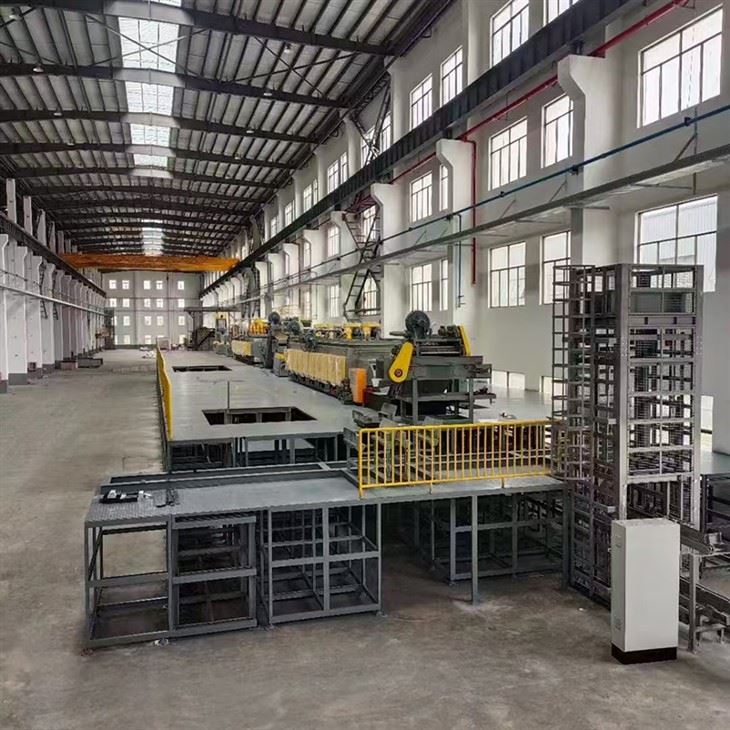


Continuous Mesh Belt Quenching Furnace Overview
The TE-Q-M series belt type quenching furnace integrates heating, carburizing, quenching and tempering into a continuous production line. The system is engineered to ensure stable furnace atmosphere, uniform heating and controlled cooling.
Thin-layer carburizing is recommended for this system, particularly for layers below 0.30mm, ensuring effective heat treatment while maintaining mesh belt durability. The equipment avoids excessive carbon black generation and improves service life under long-term operation.
Custom Industrial Quenching Furnace Key Dimensional Parameters
|
Model |
Total gross output power |
Total length(m) |
Quench size (not induding the feed table) |
After-heat furnace size (exduding the feed platform) |
|||||
|
( KW) |
Carburizing |
Tempering |
Network width |
Net belt heating |
Furnace length |
Network| width |
Net belt heating |
Furnace length |
|
|
length |
length |
||||||||
|
TE-QM-E-1 |
220 |
28.5 |
30.5 |
400 |
3.5 |
4 |
600 |
3.5 |
4 |
|
TE-QM-E-2 |
400 |
32.5 |
34.5 |
600 |
5.5 |
6 |
800 |
5.5 |
6 |
|
TE-QM-E-3 |
450 |
36.5 |
38.5 |
600 |
7.5 |
8 |
800 |
7.5 |
8 |
|
TE-QM-E-4 |
550 |
36.5 |
38.5 |
800 |
7.5 |
8 |
1000 |
7.5 |
8 |
|
TE-QM-E-5 |
650 |
40.5 |
42.5 |
800 |
9.5 |
10 |
1000 |
9.5 |
10 |
|
TE-QM-G-6 |
76000KCAL/1H |
44.5 |
46.5 |
1000 |
11.5 |
12 |
1200 |
11.5 |
12 |
|
100KW |
|||||||||
|
TE-QM-G-7 |
1250000KCAL/1H |
49 |
57 |
1200 |
12.5 |
13 |
1400 |
12.5 |
13 |
|
110KW |
|||||||||
| Note: When the tempering furnace is configured with gas blackening, the length of the furnace body increases by 2 meters. | |||||||||
Custom Belt Type Quenching Furnace Specifications Table
|
Model |
Carburizing monthly output(ton) |
Tempering monthly output (tonnes) |
Carburizing yield per hour(kg) |
Tempering hourly output (kg) |
|
TE-QM-E-1 |
58 |
115 |
80 |
160 |
|
TE-QM-E-2 |
190 |
270 |
270 |
380 |
|
TE-QM-E-3 |
210 |
290 |
300 |
410 |
|
TE-QM-E-4 |
340 |
440 |
480 |
620 |
|
TE-QM-E-5 |
540 |
610 |
760 |
860 |
|
TE-QM-6-G |
670 |
790 |
940 |
1100 |
|
TE-QM-7-G |
1000 |
1200 |
1380 |
1600 |
The furnace supports multiple thermal processes including:
•Carburizing and controlled atmosphere heating
•Quenching in oil tank system
•Tempering with stable temperature zones
•Optional blackening and protective gas processing
It is recommended to avoid overlapping workpieces during processing to ensure uniform heat distribution and avoid adhesion or deformation.


Custom Mesh Belt Furnace Structure
The furnace adopts a layered mesh belt structure with efficient heat exchange between upper and lower belts.
Each heating zone is separated by refractory bricks, ensuring temperature uniformity and stable atmosphere control.
Radiant tubes are designed for long service life and can be replaced without stopping production.
The furnace body is designed with high airtightness to prevent gas leakage and reduce energy consumption.
Custom Belt Type Quenching Furnace System Advantages
Stable Temperature Control and Continuous Operation Design
Stable Furnace Atmosphere Control
Methanol and propane gas system ensures stable atmosphere conditions, with in-furnace cracking that helps reduce carbon black formation and maintain carburizing consistency.
Accurate and Continuous Temperature Control
Each heating zone adopts SCR continuous PID control, ensuring stable temperature regulation and reliable operation during continuous production.
Reliable Continuous Operation Structure
Mesh belt transmission with idler support and stable driving system ensures smooth conveying, while zone separation maintains uniform temperature and atmosphere.
Professional
We offer a variety of transmission components, including sprockets, roller chains, gears, couplings, racks, hubs, pulleys, taper sleeves, bearing seats, and more.
Custom Mesh Belt Furnace Applications
Designed to handle continuous carburizing, quenching and tempering for small metal parts with stable and consistent results
 Fastener Industry
Suitable for continuous heat treatment of fasteners such as screws, bolts and nuts. Supports carburizing, quenching and tempering processes under stable furnace conditions.
 General Mechanical Parts
Applicable for small and medium-sized spring components. Supports quenching and tempering processes with continuous and stable operation.
 Gears
Can be used for small gears that meet mesh belt transport requirements. Suitable for carburizing and quenching with thin case depth.
 Hardware
Suitable for thin and small metal stamping parts. Supports continuous quenching and tempering processing with stable conveying.
Multi-Level Safety Devices for Continuous Furnace Operation
•Thermocouple monitoring to prevent overheating
•Mesh belt operation detection system
•Torque limiter for overload protection
•Abnormal height detection at furnace entrance
•Interlock protection to prevent equipment damage


PLC Controlled Heat Treatment Furnace System
The system uses a PLC combined with a touchscreen HMI interface to ensure reliable and stable operation.
The upper computer monitoring system supports:
•Temperature and atmosphere monitoring
•Power consumption tracking
•Historical data storage and query
•Production data recording
•Alarm visualization and fault diagnosis
Preventing Mesh Belt Misalignment and Scraping in Quenching Furnaces

Ensuring the Quality of the Mesh Belt
The surface of the mesh belt used in the quenching furnace must remain flat, and the flatness of the spiral strips must be uniform. Furthermore, the weld joints along the edges of the mesh belt must be executed with precision, ensuring that every single weld point is secure.

Precise Mesh Belt Data
Precise mesh belt data is the prerequisite for ensuring its flexible operation.

Pay attention to details
Ensuring that the mesh belt is properly tensioned and correctly positioned is crucial for preventing misalignment and wear.

Equipment Operating Status
If the mesh belt is observed to be drifting, the equipment's belt-alignment mechanism should be adjusted immediately to prevent the situation from worsening.
Custom Industrial Mesh-Belt Quenching Furnaces Expert
We are professional manufacturers of industrial heat treatment furnaces, specializing in this field for 15 years to help enterprises enhance their manufacturing efficiency.
01
Process & Equipment Expertise
With solid experience in heat treatment processes (such as carburizing and quenching), we provide not only equipment but also optimize process parameters based on your products to ensure stable and consistent results.
02
Efficient Continuous Production
The mesh belt design enables automated and continuous operation, improving productivity and product consistency while optimizing thermal efficiency to reduce energy consumption and production costs.
03
Customization & After-Sales Support
We offer tailored solutions based on different parts and production needs, along with installation, commissioning, training, and long-term technical support to ensure reliable operation.

Packaging And Transportation


Qualification Certification

conductive and insulating sealing structure

conductive and insulating sealing structure

furnace cover cooling structure

furnace cover cooling structure

Zhejiang University of Science and Technology Certificate
How to Extend the Service Life of Quenching Furnace Mesh Belts
1.What impact will the jamming, tearing, or even failure of the mesh belt in a mesh-belt heat treatment furnace have during quenching or tempering?
It will directly cause production line shutdown and economic losses.
2.What is the first key point to pay attention to when extending the service life of a quenching furnace mesh belt?
Choose the right mesh belt material. Quenching furnace mesh belts usually need to withstand temperatures around 900°C, so they require high-performance materials that can operate stably in long-term high-temperature environments.
3.What problem will occur to the mesh belt after long-term use in high-temperature environments, and how to handle it?
The mesh belt will elongate. Generally, a new mesh belt needs to be cut short in time after about 2 months of use, to prevent excessive length, congestion, and poor operation of the mesh belt.
4.What impact will improper material placement have on the mesh belt, and what is the correct practice?
If materials are placed unevenly or with improper thickness, they may leak sideways into the furnace chamber, causing material jamming. This will make the mesh belt rub against materials in the furnace for a long time, eventually leading to breakage.Correct practice: Place materials neatly with appropriate thickness to avoid material leakage.
What Should You Do If These Issues Arise with a Mesh-Belt Furnace
1. What should be done if the mesh belt in a mesh-belt quenching furnace snaps and falls inside the furnace chamber?
Pull the entire mesh belt out of the furnace. Open the cover plate located at the rear of the return channel. First, thread a piece of wire through the furnace chamber liner, then guide it through the return channel until it emerges beneath the loading platform. Lay one end of the mesh belt flat on the loading platform and securely fasten it to the wire. Two people can then pull the belt back onto the loading platform's surface, where the two ends can be spliced together using the wire-threading method.
2. How should the temperature settings be configured for a five-zone mesh-belt quenching furnace?
For a five-zone mesh-belt quenching furnace, when setting the temperatures, you may configure the two zones at the inlet and outlet ends to be slightly higher than the actual working temperature, while setting the three intermediate zones to the standard working temperature. Typically, Zone 1 is set to 780°C, while Zones 2 through 5 are set to the specific quenching temperature-for instance, 840°C.
3. How do you resolve water leakage issues in a powder metallurgy mesh-belt sintering furnace during high-temperature sintering?
If water leakage is detected in the cooling section, the affected components must be replaced or repaired. However, it is not uncommon to observe minor leakage immediately after starting up the furnace; if this phenomenon ceases after approximately 30 minutes, it is generally not a cause for concern. If the leakage persists continuously, the furnace must be shut down to allow for the replacement of the furnace core tube.
FAQ
1. What processes can this belt type quenching furnace support?
This furnace supports carburizing, quenching, tempering, and quenching & tempering processes. It can also be used for gas DX blackening under controlled atmosphere conditions.
2. What type of parts is this furnace suitable for?
It is suitable for fasteners and other standard parts, as well as small and medium-sized components with appropriate size and weight for mesh belt transportation.
3. What carburizing depth is recommended for this furnace?
Thin layer carburizing is recommended. A carburized layer less than 0.30 mm is more suitable for this type of furnace.
4. Is carbonitriding (cyaniding) supported?
Carbonitriding is not recommended, as it may affect the service life of the mesh belt and radiant tubes.
5. How is the furnace atmosphere controlled?
Methanol is used as the carrier gas and propane as the enriching gas. Methanol is gasified outside the furnace and then cracked inside to maintain a stable atmosphere.
6. How does the system reduce carbon black formation?
The cracking process of methanol inside the furnace helps reduce carbon black generation and improves gas utilization efficiency.
7. What control system does the furnace use?
The furnace uses a PLC control system combined with a touchscreen HMI, along with SCR PID temperature control for each heating zone.
8. Can the system monitor production data?
Yes, the system supports monitoring of temperature, atmosphere, and power consumption, as well as historical data storage and production record tracking.
9. What safety protections are included?
The furnace is equipped with thermocouples, mesh belt detection devices, torque limiter, abnormal height detection, and interlock protection systems.
10. Are there any requirements for loading parts?
Yes. Workpieces should be properly arranged to avoid overlapping or adhesion, especially for thin or plate-shaped parts, to ensure consistent heat treatment results.
Hot Tags: Continuous Type Quenching Furnace, China Continuous Type Quenching Furnace manufacturers, suppliers, factory, Mesh Belt Furnace, Continuous and Batch Annealing, Continuous Dehydrogenation Furnace, Belt Type Quenching Furnace, Dehydrogenation Furnace, Continuous Belt Furnaces


