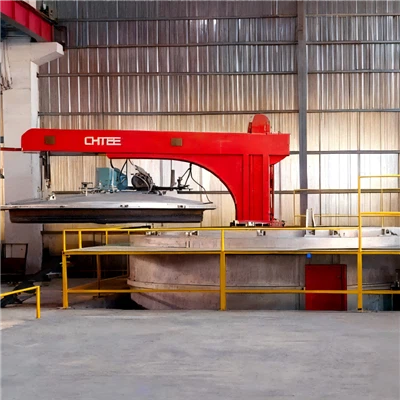
Annealing is a critical process used in various industries to alter the physical and chemical properties of materials. Through the application of heat and controlled cooling, annealing enhances material characteristics such as ductility, hardness, and overall structure. This process is commonly employed in metallurgy, steel manufacturing, and other material sciences. Please continue reading to learn about the basic principles of annealing, the types of annealing furnaces, and their importance in industrial production.

What is Annealing?
Annealing is a heat treatment process used to soften metals or alloys, allowing them to achieve the desired mechanical properties. During annealing, a material is heated to a specific temperature, maintained for a certain period, and then gradually cooled. The goal is to relieve internal stresses, improve machinability, refine grain structure, and enhance the material's flexibility. This process is essential in industries where materials need to meet precise mechanical and structural standards.


Types of Annealing
There are several types of annealing processes, each tailored for specific material properties or applications:
1.Full Annealing:This is a comprehensive annealing process used to soften metals. The material is heated above its critical temperature and then allowed to cool slowly, typically in a furnace. This results in the formation of a uniform, fine-grained structure, improving the material's ductility and machinability.
2.Spheroidizing:This type of annealing involves heating steel to a temperature below its critical point to form spheroidized carbides. It is used mainly for high-carbon steels and enhances machinability by making the material more uniform.
3.Stress Relief Annealing:This process is designed to reduce the internal stresses that arise from machining or welding processes. Stress relief annealing typically uses lower temperatures and short heating times compared to full annealing.
CHTEE's Annealing Furnace
Founded in 2018, CHTEE is a leading industrial heat treatment furnaces manufacturer, focusing on providing efficient and reliable industrial furnace solutions to global customers. With over 20 years of industry experience, our equipment is widely used in the steel, non-ferrous metals, automotive parts, and aerospace industries, and has successfully expanded into international markets such as the Middle East and Africa. We are experts in customized industrial heat treatment furnaces.
Our products encompass specialized annealing furnaces for the steel industry, automated hot-dip galvanizing production lines, and corrosion-resistant heating furnaces, all incorporating advanced technology and rigorous quality management. As an integrated enterprise encompassing design, manufacturing, installation, and after-sales service, we not only provide customized equipment but also offer comprehensive plant planning and technical support to our clients.
Car Bottom Annealing Furnace
◆ Designed for large and heavy workpieces.
◆ Movable car allows for easy loading and unloading of materials.
◆ Ideal for parts that require long heating durations.
◆ Operates in controlled atmospheres to prevent oxidation during the process.

|
Serial Number |
Mode |
Power |
MHximum charging capacity |
Loading size |
External dimensions |
Crane height |
|
1 |
TE-A-T-E-100/100/100 |
75KW |
2T |
L1000*W1000*H1000 |
L2400*W3000*H2200 |
4500mm |
|
2 |
TE-A-T-E-180/100/100 |
150KW |
5T |
L1800*W1000*H1000 |
L4000*W3000*H2200 |
4500mm |
|
3 |
TE-A-T-E-180/180/180 |
245KW |
12T |
L1800*W1800*H1800 |
L4000*W3000*H3000 |
5500mm |
|
4 |
TE-A-T-E-360/180/180 |
310KW |
16T |
L3600*W1800*H1800 |
L7500*W3000*H3000 |
5500mm |
|
5 |
TE-A-T-E-540/180/180 |
400KW |
22T |
L5400*W1800*H1800 |
L12600*W3000*H3000 |
5500mm |
|
6 |
TE-A-T-E-720/180/180 |
500KW |
28T |
L7200*W1800*H1800 |
L16200*W3000*H3000 |
5500mm |
|
7 |
TE-A-T-E-900/180/180 |
600KW |
36T |
L9000*W1800*H1800 |
L20000*W3000*H3000 |
5500mm |
Well-Type Annealing Furnace
A pusher annealing furnace uses a mechanical pusher to move workpieces through the furnace on a continuous conveyor. It is highly efficient for processing long, continuous materials such as rods, bars, and strips.
◆ High throughput and efficient continuous processing.
◆ The mechanical pusher ensures a steady and consistent flow of materials through the furnace.
◆ Often equipped with multiple heating zones for precise temperature control.

|
Serial Number |
Model |
Power |
Natural gas |
MHximum charging capacity |
Loading size |
External dimensions |
Crane height |
|
1 |
TE-A-MH-G-240/240 |
45KW |
60m³/H |
16T |
φ2400*H2400 |
φ3900*H3350 |
7500mm |
|
2 |
TE-A-MH-G-280/240 |
65KW |
80m³/H |
24T |
φ2800*H2400 |
φ4300*H3350 |
7500mm |
|
3 |
TE-A-MH-G-320/240 |
65KW |
100m³/H |
28T |
φ3200*H2400 |
φ4700*H3350 |
7500mm |
|
4 |
TE-A-MH-G-360/240 |
85KW |
120m³/H |
32T |
φ3600*H2400 |
φ5100*H3350 |
7500mm |
|
5 |
TE-A-MH-G-360/340 |
95KW |
150m³/H |
36T |
φ3600*H3400 |
φ5100*H4350 |
9500mm |
Vertical Vacuum Annealing Furnace
A vacuum annealing furnace operates under a vacuum or controlled atmosphere, preventing oxidation and contamination of the materials during annealing. This furnace type is used for high-purity materials and sensitive applications.
◆ Operates in a vacuum or inert gas atmosphere, preventing oxidation.
◆ Suitable for processing high-purity materials such as titanium, aerospace alloys, and semiconductor components.
◆ Provides precise temperature control for uniform heating.

|
Serial Number |
Model |
Power |
MHximum charging capacity |
Loading size |
External dimensions |
Crane height |
|
1 |
TE-A-MA-W-180/240 |
200KW |
8T |
φ1800*H2400 |
φ3200*H3250 |
5500mm |
|
2 |
TE-A-MA-W-240/240 |
300KW |
16T |
φ2400*H2400 |
φ3800*H3250 |
5500mm |
|
3 |
TE-A-MA-W-340/240 |
400KW |
20T |
φ3200*H2400 |
φ4800*H3250 |
5500mm |
|
4 |
TE-A-MA-W-360/240 |
500KW |
24T |
φ3600*H2400 |
φ5200*H3250 |
5500mm |
Pit Annealing Furnace
A pit annealing furnace, also known as a "down-draft" or "pit-type" furnace, is typically installed below ground level and is used for batch processing of large, bulky materials. The furnace is ideal for heat treatment of materials that are too large for other furnace types.
◆ Suitable for large, bulky workpieces that cannot be processed in other furnace types.
◆ High thermal mass ensures stable temperature control.
◆ Simple design with excellent heat retention capabilities.

|
Serial Number |
Model |
Power |
MHximum charging capacity |
Loading size |
External dimensions |
Crane height |
|
1 |
TE-A-MH-E-100/200 |
145KW |
4T |
φ1000*H2000 |
φ2300*H2950 |
6700mm |
|
2 |
TE-A-MH-E-180/240 |
200KW |
8T |
φ1800*H2400 |
φ3100HB350 |
7500mm |
|
3 |
TE-A-MH-E-240/240 |
320KW |
16T |
φ2400*H2400 |
φ3700*H3350 |
7500mm |
|
4 |
TE-A-MH-E-280/240 |
420KW |
20T |
φ2800*H2400 |
φ4100*H3350 |
7500mm |
|
5 |
TE-A-MH-E-320/240 |
460KW |
24T |
φ3200*H2400 |
φ4500*H3350 |
7500mm |
|
6 |
TE-A-MH-E-360/240 |
520KW |
28T |
φ3600*H2400 |
φ4900*H3350 |
7500mm |
|
7 |
TE-A-MH-E-360/340 |
580KW |
32T |
φ3600*H3400 |
φ4900*H4350 |
9500mm |
Working Principle of Annealing Furnaces
Annealing furnaces are designed to provide controlled environments that allow for precise temperature regulation. The key factors in the operation of an annealing furnace include:
1.Temperature Control:The furnace is heated to a specific temperature based on the material's requirements. Accurate temperature control is essential for achieving the desired material properties. Overheating or underheating can lead to unwanted outcomes such as oxidation or incomplete phase changes.
2.Uniform Heat Distribution:A critical feature of an annealing furnace is the even distribution of heat. To achieve this, many furnaces use forced convection or radiant heat sources. Uniform heating ensures that the material undergoes the same treatment throughout, improving consistency and quality.
3.Controlled Atmosphere:In many annealing processes, the furnace environment must be controlled to prevent oxidation or contamination of the material. This is particularly important in materials like steel, where an inert or reducing atmosphere (e.g., nitrogen, hydrogen, or vacuum) is often maintained.
4.Cooling Process:The cooling rate is as important as the heating phase. The material must cool at a controlled rate to achieve the desired mechanical properties. Cooling may occur within the furnace (furnace cooling), in air, or through quenching in water or oil, depending on the material type.
Components of an Annealing Furnace
1.Heating Elements:The primary function of heating elements is to raise the temperature of the furnace to the desired level. These elements may be electric or gas-powered and are often designed to provide heat evenly across the entire furnace chamber.
2.Furnace Chamber:The chamber is where the materials are placed during the annealing process. It is designed to accommodate the items being treated and ensure they are exposed to uniform temperature and controlled atmosphere.
3.Insulation:High-quality insulation materials are essential to maintain consistent temperatures inside the furnace. Insulation minimizes heat loss and improves the energy efficiency of the annealing process.
4.Temperature and Atmosphere Control Systems:Annealing furnaces are equipped with advanced control systems to regulate both temperature and the atmosphere inside the chamber. These systems provide real-time feedback, ensuring that the heating and cooling cycles are executed correctly.
Applications of Annealing Furnaces
Annealing furnaces are crucial in several industries, including:
1.Metallurgy:In the metallurgy industry, annealing is used to refine the microstructure of metals like steel, aluminum, and copper, making them more suitable for further processing like rolling, welding, and forming.
2.Automotive Manufacturing:Automotive parts often undergo annealing to enhance their formability and strength. Components like suspension springs, engine valves, and transmission gears are treated to improve durability.
3.Electronics Industry:In electronics, annealing is used to relieve stress in thin metal films and wire components, enhancing their conductivity and reliability.
4.Aerospace:Aerospace materials, which require high strength-to-weight ratios, are often treated using annealing furnaces to achieve optimal mechanical properties.
Benefits of Annealing
1.Enhanced Ductility:By softening metals and alloys, annealing increases their ductility, making them easier to shape, bend, and machine without cracking.
2.Improved Strength and Durability:The process can help improve the overall strength of materials, ensuring they meet the stringent requirements of various applications, from structural components to electrical conductors.
3.Stress Relief:Annealing eliminates internal stresses caused by previous manufacturing processes, reducing the likelihood of warping or cracking during later operations.
4.Uniform Microstructure:The heat treatment leads to a more uniform microstructure, which is crucial for the consistent mechanical properties of the material.