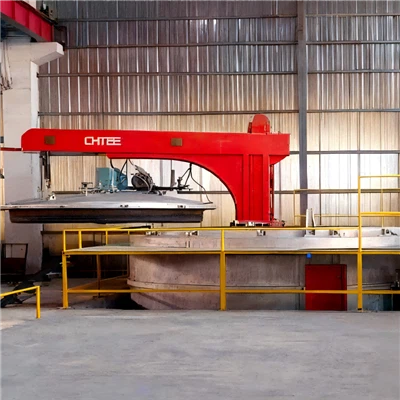

What Is an Atmosphere Furnace?
An controlled atmosphere furnace is a type of high-temperature industrial furnace designed to operate within a controlled gas environment. Instead of heating materials directly in air, it maintains a specific gas composition-called an atmosphere-inside the chamber to influence how materials react, oxidize, or harden during heat treatment processes.
This controlled atmosphere is usually made up of gases such as nitrogen (N₂), argon (Ar), hydrogen (H₂), or other reducing or protective gases, depending on the application and material being processed.
Main Applications
Atmosphere furnaces are widely used in:
Metallurgical heat treatment, including annealing, quenching, carbonitriding, and tempering.
Powder metallurgy and ceramic sintering, where controlled gas flow prevents oxidation and promotes densification.
Surface protection during high-temperature processing, ensuring no oxidation or decarburization occurs.
Laboratory research and material testing, where stable environmental conditions are required.
Working Principle
The atmosphere furnace operates through several controlled stages:
Purging air from the chamber – The internal air is evacuated or flushed out to remove oxygen.
Introducing process gas – Specific gases are introduced (e.g., N₂, H₂, or Ar) to create a reducing or inert atmosphere.
Heating to the required temperature – The furnace is raised to the process temperature, ensuring precise heat distribution.
Soaking period – The material is held at temperature under the controlled gas environment.
Cooling or quenching – Some furnaces integrate controlled cooling or quenching in the same atmosphere to preserve surface quality.
Advantages of an Atmosphere Furnace
Atmosphere control: The furnace can precisely regulate gas composition, flow, and pressure to control oxidation or reduction.
Improved surface quality: Prevents oxidation, scaling, or decarburization-especially critical for precision parts like custom bronze bushings.
Versatility: Supports different gas types (protective, reducing, carburizing, or nitriding) for varied processes.
Temperature accuracy: Combines advanced temperature and gas control systems for consistent quality.
Energy efficiency: Modern controlled atmosphere heat treatment furnace minimize material loss and reduce emissions compared to open-air furnaces.
Comparison with Other Furnaces
|
Type |
Main Feature |
Gas Control |
Typical Use |
|---|---|---|---|
|
Muffle Furnace |
Isolated chamber, air atmosphere |
None |
General lab heating |
|
Vacuum Furnace |
Operates under vacuum |
Minimal or no gas |
High-purity materials |
|
Atmosphere Furnace |
Controlled gas environment |
Full control |
Heat treatment, sintering, alloy processing |
Safety and Maintenance
Seal integrity: The furnace must be airtight; leaks can ruin the gas composition.
Gas safety: Hydrogen and other reducing gases require strict monitoring to prevent explosions.
Regular calibration: Flow meters, gas analyzers, and thermocouples should be calibrated frequently.
Cooling management: Controlled cooling helps avoid thermal shock and maintains part quality.
What Is A Vacuum Atmosphere Furnace?
A vacuum atmosphere furnace is a type of high-temperature heat treatment equipment that combines vacuum technology with controlled atmosphere processing technology.
Simply put, the furnace chamber can be both vacuumed (or low-pressure) and filled with a specific gas, thereby controlling the atmosphere within the furnace and allowing materials to be heated and processed in a controlled environment.
Vacuum Atmosphere Furnace Vs. Atmosphere Furnace Technical Comparison
| Feature | Atmosphere Furnace | Vacuum Atmosphere Furnace |
|---|---|---|
| Gas Purity | Moderate | Extremely high, almost oxygen-free |
| Oxidation Control | Good | Excellent - near zero oxidation |
| Temperature Uniformity | Stable | Very uniform due to vacuum isolation |
| Energy Consumption | Lower | Higher, due to vacuum pump systems |
| Equipment Cost | Lower | Higher - more complex structure |
| Operating Temperature | Up to 1300 °C | Up to 1600 °C or higher |
| Safety | Requires gas safety (especially H₂) | High stability, but high cost |
List of Top 10 Atmosphere Furnace Suppliers
Haiyan Teyi Intelligent Technology Co., Ltd. is a China-based company specializing in the research, development, and manufacturing of high-end heat treatment equipment, with particular strength in atmosphere and vacuum furnaces. Its product line includes protective atmosphere chamber furnaces, nitrogen/argon protective atmosphere furnaces, and low-vacuum + atmosphere combination furnaces.
The company emphasizes integrated optimization of furnace design, atmosphere control systems, and automated temperature control to improve heat treatment consistency and efficiency. Its equipment not only supports standard models but also offers customized furnace dimensions, atmosphere types, and cooling methods based on customer workpieces.
Teyi also offers a global after-sales service network and online monitoring and data tracking capabilities, allowing users to monitor furnace temperature, gas composition, residual oxygen/humidity levels, and other parameters in real time. Combined with the cost advantages of manufacturing in China and international certifications such as CE and ISO 9001, Teyi is a top choice for domestic and international customers seeking atmosphere furnaces.
The company produces batch and continuous-type atmosphere furnaces, vacuum furnaces, and gas generators for industries such as aerospace, automotive, mining, gear manufacturing, and aluminum processing.
3. Ipsen International Holding GmbH
The company's product portfolio includes pusher furnaces, mesh-belt furnaces, and rotary furnaces used for hardening steels, titanium alloys, and components in the wind, energy, and aerospace sectors. Ipsen operates production sites in Germany, the U.S., and India, offering advanced atmosphere control and automation systems.
The company offers both laboratory-scale and large commercial systems for powder metallurgy, aerospace, ceramics, and material research. Its furnaces can reach extreme temperatures and ultra-high vacuum levels, providing consistent performance in demanding environments.
Nabertherm is a renowned German manufacturer offering a wide range of industrial furnaces, including its Protective Atmosphere Furnace series. These systems reach temperatures up to 1300 °C and are used across automotive, aerospace, and technical ceramics industries. The company supports both standard and fully customized designs to suit diverse production requirements.
Camco Furnace specializes in hydrogen and inert gas atmosphere furnaces, as well as high-vacuum thermal systems. The company's products are ideal for applications requiring reducing or inert atmospheres rather than complete vacuum environments. Known for reliability and user-friendly controls, Camco also provides fully customized system integrations.
Its atmosphere furnace line is optimized for oxidation prevention, heat treatment, and sintering processes in laboratory and pilot-scale production.
8. Vacuum Atmospheres
While its core business is gloveboxes and sealed process chambers, its gas-handling technology is widely used in heat treatment and atmosphere control systems requiring precise gas composition management.
Located in Allenstown, New Hampshire, MRF Inc. designs laboratory and high-temperature furnaces, including controlled atmosphere units for aerospace, nuclear, and communication industries. The company is known for engineering excellence, safety, and service in high-specification furnace design.
Its systems emphasize productivity, energy efficiency, and long-term reliability in demanding industrial environments.
Questions Buyers Want To Know About Controlled Atmosphere Furnace
1. What are the key factors to consider when purchasing an atmosphere furnace?
When purchasing an atmosphere furnace, there are several key questions to consider to ensure the equipment is suitable for your process needs.
What are the part types, materials, sizes, and batch sizes you process? These factors determine the furnace size, processing capacity, and atmosphere type.
Is your heat treatment process based on a vacuum furnace or an atmosphere furnace? Different processes (such as annealing, carburizing, and nitriding) require different atmosphere control, vacuum pumping capacity, and gas type.
What is your budget? In addition to the equipment itself, consider auxiliary equipment (gas generators, flow control systems, cooling systems) and installation/operation costs.
Do your factory space, cooling water system, and gas supply meet the requirements? Atmosphere furnaces often require a stable supply of gases (such as inert gases and reducing gases) as well as supporting facilities.
2. Why is gas composition and control so important in atmosphere furnaces?
Atmosphere furnaces control the gas composition within the furnace chamber to prevent oxidation, decarburization, and other chemical reactions, thereby protecting the workpiece or promoting desired metallographic changes.
During high-temperature processing, if the air contains oxygen, water vapor, or other gases, the material surface may oxidize, decarburize, or be infiltrated by foreign impurities, affecting mechanical properties and surface quality.
By introducing protective or reducing gases such as nitrogen, hydrogen, and argon, the air environment can be replaced, providing a stable chemical environment to maintain the material's original state or achieve the desired heat treatment effect.
When designing an atmosphere furnace, it is necessary to select an appropriate gas mixture (such as an N₂-H₂ mixture, inert gas, or reducing gas) and equip it with gas analysis, flow control, and residual oxygen monitoring devices to achieve precise control.
Therefore, gas composition and control directly affect the final performance, surface condition, and production stability of the workpiece, and are crucial elements that cannot be ignored in atmosphere furnace applications.
3. What are the main differences between an atmosphere furnace and a vacuum furnace?
Atmosphere furnaces: These furnaces operate at normal or slightly above atmospheric pressure, controlling the atmosphere around the workpiece by introducing a series of specific gases (such as nitrogen, argon, and hydrogen) to prevent direct contact with air and prevent oxidation and decarburization.
Vacuum/Atmosphere Hybrid furnaces: First, a vacuum is drawn to remove air and impurities from the furnace chamber. Then, protective or reducing gases are introduced, allowing heat treatment to proceed in a low-pressure environment. The advantages of these furnaces are higher purity, less residual oxygen, and less interference with chemical reactions.
In addition, the two furnaces differ in cost and operating conditions: Atmosphere furnaces are generally cheaper to purchase and operate and are suitable for high-volume production; whereas vacuum furnaces require complex equipment and are more expensive, suitable for applications requiring extremely high surface purity or for special materials (such as titanium alloys and aerospace materials).
4. What are common operating/maintenance issues with atmosphere furnaces?
If heating times are too long or the target temperature is not reached, there may be a problem with the furnace's air circulation system, or the air flow damper may not be open, or the fan may not be operating properly. If the temperature rises too quickly or exceeds the preset value, the controller parameters (such as PID) may not be adjusted correctly, or there may be a problem with the control instrumentation or thermocouple.
If the temperature is cooling down or decreasing slowly, there may be a problem with the cooling system/circulating air/cooling medium. Alternatively, the furnace may be overloaded, affecting gas flow.
To prevent these problems, it is recommended to regularly check the gas seals, blower, damper, thermocouple, and controller parameters, and maintain proper furnace load, gas flow, and safety systems.
Therefore, good routine maintenance (including the gas system, air circulation, and temperature control system) is crucial for stable atmosphere furnace operation.
5. Why use nitrogen or argon as a shielding gas?
Nitrogen (N₂), a common shielding gas, replaces oxygen in air, providing an "inert barrier" for metals to prevent oxidation and decarburization. While nitrogen is not completely inert, it can meet the required shielding requirements for most steels and non-ferrous alloys.
Argon (Ar) is a true inert gas and is very suitable for materials that require higher purity protection (such as aluminum, copper, rare alloys) or processes that require extremely low oxygen content.