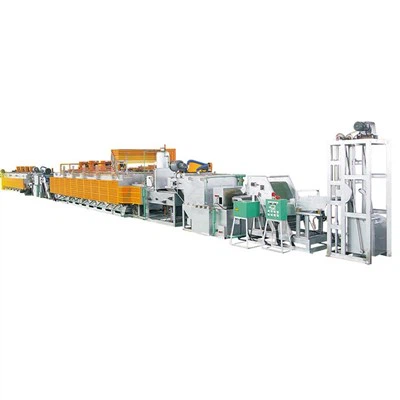

Belt type Quenching Furnace for Transmission Parts Parameter
Furnace dimensions and production capacity are configured according to transmission part size and heat treatment requirements.
| Parameter | Specification |
|---|---|
| Furnace Type | Belt Type Quenching Furnace |
| Main Process | Carburizing / Quenching / Tempering |
| Application | Transmission Parts |
| Suitable Parts | Gears / Shafts / Gear Rings / Synchronizer Components |
| Heating Method | Electrical or Gas Heating |
| Atmosphere | Controlled Carburizing Atmosphere |
| Transportation | Continuous Mesh Belt |
| Quenching Medium | Quenching Oil |
| Control System | PLC + HMI |
| Temperature Control | Multi-Zone Control |
| Production Mode | Continuous |
| Belt Width | Customized |
| Furnace Length | Customized |
| Quenching Capacity | Configured according to production requirements |
| Production Capacity | Customized according to component type and output |
Quenching Furnace Main Applications
Continuous heat treatment for transmission gears, shafts and other drivetrain components.
The belt type quenching furnace is suitable for steel transmission components that require surface hardening, wear resistance and controlled mechanical properties.
Typical transmission parts include:
- Transmission gears
- Gear rings
- Planet gears
- Input shafts
- Output shafts
- Countershafts
- Gear shafts
- Synchronizer components
Other small and medium-sized drivetrain parts
The final furnace configuration depends on component material, dimensions, loading condition, required case depth and production capacity.
Carburizing and Quenching Process
A controlled heat treatment cycle helps transmission components achieve the required surface and core properties.
Carburizing
The carburizing section increases the carbon concentration at the component surface.
Process parameters can be adjusted according to steel grade, component size and required carburized layer depth.
Heating
Multiple heating zones provide separate temperature control during the heat treatment cycle.
The controlled heating process supports stable temperature distribution across the working area.
Quenching
After carburizing, the components enter the quenching section for rapid cooling.
The quenching system controls oil circulation and agitation to maintain consistent cooling conditions.
Tempering
The tempering stage adjusts the properties of quenched components and reduces internal stress before subsequent inspection or machining.
Continuous Mesh Belt
Transmission components move through the furnace on a continuous mesh belt.
The controlled belt speed determines the residence time of components in each treatment zone.
Multi-Zone Heating
The heating furnace uses multiple temperature zones for independent thermal control.
Each zone can be adjusted according to the required carburizing and heating cycle.
Carburizing Atmosphere
A controlled atmosphere is maintained inside the carburizing furnace.
Methanol can be used as carrier gas, with enriching gas supplied according to process requirements.
Atmosphere control helps maintain stable carburizing conditions during continuous operation.
Oil Quenching System
The quenching section uses controlled oil circulation and agitation.
The system provides a stable cooling environment for components leaving the carburizing section.
Tempering Furnace
A tempering furnace can be integrated into the production line for continuous post-quenching treatment.

Technical Advantages
Furnace configuration focuses on process consistency, temperature control and transmission part quality.
Stable Temperature Control
Independent heating zones allow the temperature profile to be adjusted according to different stages of the heat treatment process.
Controlled Carburizing
The atmosphere system supports controlled carbon potential and carburized layer development.
Uniform Quenching
Oil circulation and agitation improve cooling consistency across the quenching area.
Continuous Processing
The mesh belt system moves components through the complete heat treatment cycle without repeated manual transfer.
Reduced Process Variation
Integrated control of temperature, atmosphere, belt speed and quenching conditions helps maintain repeatable production parameters.
Flexible Furnace Configuration
Belt width, furnace length, heating zones, quenching capacity and production output can be configured according to transmission component requirements.
FAQ
1.Can the furnace process transmission shafts?
Yes. Suitable input shafts, output shafts, gear shafts and other steel shafts can be processed according to material and heat treatment requirements.
2.Can the carburized case depth be controlled?
Yes. Carburizing parameters can be adjusted according to material grade, component dimensions and required case depth.
3.How does the furnace control quenching?
The quenching system uses controlled oil circulation and agitation to maintain stable cooling conditions.
Hot Tags: belt type quenching furnace for transmission parts, China belt type quenching furnace for transmission parts manufacturers, suppliers, factory, Batch Hearth Furnace, Batch Integral Quench Furnaces, quenching furnace