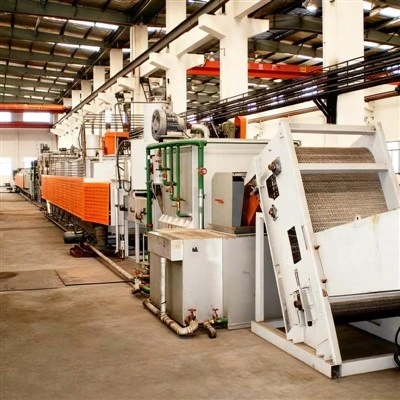

Belt-type Quenching Furnace For Bearing Components Parameter
Furnace capacity and configuration can be matched to bearing component dimensions and production requirements.
| Parameter | Specification |
|---|---|
| Furnace Type | Belt-type Quenching Furnace |
| Main Process | Hardening / Quenching / Tempering |
| Application | Bearing Components |
| Suitable Parts | Bearing Rings / Rollers / Sleeves / Small Bearing Components |
| Heating Method | Electrical or Gas Heating |
| Atmosphere | Controlled Protective Atmosphere |
| Transportation | Continuous Mesh Belt |
| Quenching Medium | Quenching Oil |
| Control System | PLC + HMI |
| Temperature Control | Multi-Zone Control |
| Production Mode | Continuous |
| Belt Width | Customized |
| Furnace Length | Customized |
| Quenching Capacity | Configured according to component requirements |
| Production Capacity | Customized according to component type and output |
Required Hardness
Controlled heating and quenching help bearing components reach the specified hardness range.
Stable hardness is important for components exposed to repeated rolling and contact loads.
Wear Resistance
Bearing surfaces experience repeated contact during operation.
Proper hardening increases surface resistance to wear and supports longer component service life.
Dimensional Stability
Bearing rings and rollers require tight dimensional control during manufacturing.
Controlled thermal cycles and quenching conditions help limit heat treatment deformation.
Consistent Metallurgical Structure
Stable heating and cooling conditions help produce a consistent hardened structure throughout the processed components.
Reduced Heat Treatment Variation
Continuous belt transportation and automated process control reduce variation caused by inconsistent loading or manual process handling.

Technical Advantages
The furnace focuses on repeatable hardening, controlled cooling and stable production of bearing components.
Uniform Heating
Multi-zone temperature control helps maintain consistent heating conditions across the working area.
Controlled Quenching
Oil circulation and agitation provide controlled cooling conditions for different component sizes.
Stable Belt Speed
Adjustable belt speed allows the residence time to match the required hardening cycle.
Reduced Oxidation
Protective atmosphere operation helps reduce surface oxidation during heating.
FAQ
1.What bearing steel can be processed?
Common bearing steels such as GCr15 and other suitable bearing steel grades can be processed according to their required heat treatment parameters.
2.What is the main purpose of hardening bearing components?
Hardening increases the hardness and wear resistance required for bearing components operating under repeated rolling and contact loads.
3.How is deformation controlled?
Controlled heating, stable belt transportation and properly configured quenching conditions help reduce heat treatment deformation.
For precision bearing components, the process should be developed according to dimensional tolerances and subsequent grinding requirements.
Hot Tags: belt-type quenching furnace for bearing components, China belt-type quenching furnace for bearing components manufacturers, suppliers, factory, Batch Hearth Furnace, Batch Integral Quench Furnaces, quenching furnace