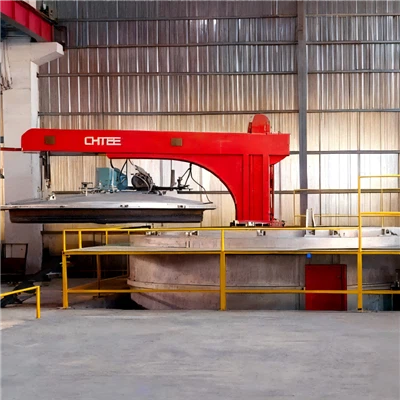
What Is The Function Of A Mesh Belt Furnace?
A mesh belt furnace is a continuous, controlled atmosphere heat treatment equipment. It utilizes a high-temperature resistant metal mesh belt to uniformly transport workpieces, automatically completing the entire process from feeding, preheating, high-temperature heating, holding, slow cooling to discharging.
The equipment can precisely control the furnace temperature and protective atmosphere, effectively preventing oxidation, decarburization, and deformation of workpieces during heating. It is mainly used for quenching, tempering, annealing, normalizing, carburizing, carbonitriding, and stress-relief annealing of metal parts. It is also suitable for processes such as sintering of powder metallurgy products, drying and curing of electronic components, and bright heat treatment of hardware parts.
It features a high degree of automation, stable operation, uniform temperature, and large batch capacity. It is suitable for the large-scale continuous production of small and medium-sized standard parts, chains, bearings, automotive parts, hardware tools, and powder metallurgy products. It is an indispensable key heat treatment equipment in the machinery manufacturing, hardware processing, automotive, electronics, and new materials industries.

What Are The Basic Parameters Of The Continuous Type Quenching Furnace?
- Max Temperature: 100 ~ 1200 °C
- Furnace Chamber Dimensions: Customized according to the user's production capacity and process requirements
- Power: 100 kW - 2000 kW
- Heating Elements: Resistance wires, silicon carbide (SiC) heating rods
- Temperature Zones: Configurable according to process requirements
- Temperature Control: Independent control at each temperature zone, centralized control via PLC touchscreen
- Production Capacity: Customized according to the user's production requirements
- Belt Speed: Variable frequency adjustable
- Applicable Atmospheres: Vacuum, oxidizing atmosphere, inert atmosphere, reducing atmosphere
- Loading/Unloading: Automated conveyor-based loading and unloading
- Applicable Processes: Chip soldering, metal packaging, metallization, brazing, oxidation, annealing, etc.

What Are The Technical Advantages Of Industrial Mesh Belt Furnaces?
Continuous Automated Production:The entire process is automated with mesh belt conveyor, integrating feeding, heating, holding, cooling, and discharging. Frequent manual loading and unloading is unnecessary, making it suitable for large-scale assembly line operations. Production efficiency is significantly higher than batch furnaces.
Uniform Temperature and High Temperature Control Precision: Utilizing independent temperature control in multiple zones, the furnace exhibits a uniform temperature distribution, stable heating, and consistent workpiece heating. This results in good consistency in hardness and metallographic structure after heat treatment, leading to a high product qualification rate.
Controllable Atmosphere Protection and High Workpiece Quality:Protective atmospheres such as nitrogen and pyrolysis gases can be introduced, preventing workpiece oxidation and decarburization during heating, resulting in a bright surface and minimal deformation, eliminating the need for subsequent grinding and rust removal processes.
Wide Applicability and Versatility: Capable of processing screws, fasteners, bearings, chains, small hardware parts, and automotive components. It can also be used in powder metallurgy sintering, electronic component drying and curing, glass annealing, and other processes.
Energy-saving and heat-insulating, low operating cost: The furnace body uses high-quality refractory insulation materials, minimizing heat loss; waste heat can be recovered and reused, resulting in rapid heating, low energy consumption, and long-term savings in electricity and gas.
Stable structure and long service life: Utilizing a high-temperature resistant alloy mesh belt and heat-resistant furnace lining, it is resistant to high temperatures, deformation, and corrosion, resulting in a low equipment failure rate and simple maintenance.
Highly adjustable process: The mesh belt speed, temperature of each temperature zone, and atmosphere flow rate can all be steplessly adjusted, flexibly adapting to different heat treatment processes such as quenching, tempering, annealing, carburizing, and sintering.

What Are The Application Areas Of Mesh Belt Furnaces?
Standard parts hardware industry: Suitable for screws, nuts, rivets, chains, springs, and small hardware parts, for continuous quenching, tempering, stress relief, and bright annealing.
Automotive parts industry: Used for automotive bolts, gears, shafts, valves, small chassis parts, and transmission components, for carburizing, carbonitriding, tempering, and bright quenching to ensure strength and wear resistance.
Bearing and mechanical parts industry: Continuous heat treatment of various miniature bearings, needle rollers, rollers, and precision mechanical parts, resulting in minimal deformation, uniform hardness, and good batch stability.
Powder metallurgy industry: High-temperature sintering, reduction, and densification of iron-based and copper-based powder metallurgy parts, oil-impregnated bearings, and structural components, followed by shaping under a protective atmosphere.
Stainless steel and medical device industry: Bright annealing and solution treatment of small stainless steel parts, knives, tableware, locks, hinges, and medical accessories, ensuring no surface oxidation or discoloration.
Electronics and New Energy Industry: Drying, debinding, sintering, and curing processes for electronic ceramics, magnetic materials, battery materials, component substrates, and thick-film circuits.
Bragging and special heat treatment industries: Atmosphere brazing of heat exchangers, radiators, and hard alloy components, as well as glass annealing, ceramic sintering, and drying and curing of special materials.
What Are The Technological Development Trends Of Mesh Belt Furnaces?
Intelligent Automation: Full-process PLC intelligent control supports remote monitoring, process storage, and fault early warning, enabling automated continuous production and reducing manual intervention.
Precision Temperature Control and Atmosphere:Precise temperature control across multiple temperature zones, automatic adjustment of carbon potential and atmosphere, resulting in workpiece heat treatment with no oxidation, minimal deformation, and high quality consistency.
Energy Saving and Environmental Protection:Utilizing new insulation materials and waste heat recovery structures reduces energy consumption; equipped with exhaust gas treatment, meeting low-carbon and environmentally friendly production requirements.
Reliable Structure and Easy Maintenance:Modular furnace design, high-temperature resistant mesh belt with anti-deviation structure, resulting in long equipment life, low failure rate, and convenient maintenance.
Integrated and Flexible Processes:One machine is compatible with multiple processes such as quenching, tempering, sintering, and brazing, and can be integrated with upstream and downstream processes to form automated production lines, adaptable to multi-variety production.
Specialized Customization:Customized solutions are available for industries such as automotive, standard parts, powder metallurgy, and new energy electronics to meet the special heat treatment needs of high-end workpieces.
✔ 5000+ Installed Furnaces
✔ Custom Design Support