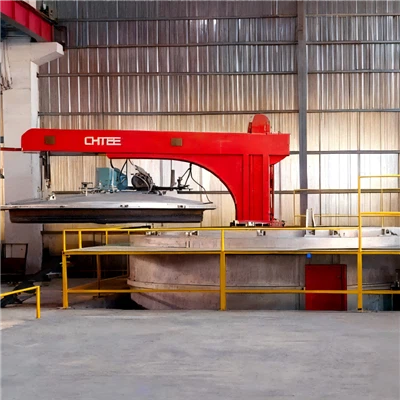
The Concept of Bell-Type Annealing Furnaces
A bell-type annealing furnace is an intermittent annealing device. It generally consists of a furnace platform, a heating hood, an inner hood, and a cooling hood. The coiled strip is stacked and placed inside the inner hood. The heating hood is placed outside the inner hood for heating and heat preservation. After the set time is reached, the heating hood is removed and replaced with a cooling hood for air cooling or water cooling.
Bell-type furnaces are further classified into electric furnaces and gas furnaces based on their heat source. Electric furnaces use resistance wire heating, which is simpler to control, requires less initial investment, and has lower maintenance costs, but electricity prices are high, resulting in higher operating costs. Gas heating, although more complex, has lower operating costs. Based on current market prices, providing the same amount of heat using natural gas combustion costs approximately one-third of the cost of electric heating. Therefore, more and more cold-rolling manufacturers are choosing gas heating when purchasing annealing furnaces.
The Significance Of The Bell-type Furnace Annealing Process Control System
Annealing temperature is the most important process parameter in a bell-type furnace. The quality of temperature control directly affects the quality of the annealed products. Therefore, the accuracy of temperature control represents the level of control over the bell-type furnace annealing process.
Application Cases Of Bell-type Annealing Furnace For Processing Copper Alloys
The material to be annealed in the bell-type furnace is copper and copper alloy strip as specified in the product outline. Its performance parameters are as follows:
Material Types: C10100, C10200, C11000, C12200, C14300, C26000, C27000, C19400, C19210, C15500, C52100
Material Thickness: 0.1-16mm
Material Width: 650-1250mm
External Dimensions: Maximum outer diameter Φ2000mm, inner diameter Φ610mm, width 650mm, 850mm, 1250mm
Loading Quantity: 650mm wide: 4 rolls/furnace; 850mm wide: 3 rolls/furnace; 1250mm wide: 2 rolls/furnace Furnace
Bell-type furnaces are mainly used for intermediate annealing and finished product annealing of copper and copper alloys, including hard and semi-hard products. Annealing temperatures range from 250 to 700℃. The process requires heating the material to a set temperature at a specific heating rate, holding it at that temperature for a period of time to ensure uniform internal temperature, and then slowly cooling it to room temperature.

Copper and copper alloys are prone to oxidation and gas absorption during annealing. Oxidation causes metal loss and darkens the surface, while gas absorption often leads to intergranular brittleness. To prevent oxidation and gas absorption and improve workpiece surface quality, annealing is often performed in a protective atmosphere or vacuum, a process known as bright annealing.
Due to the easy leakage and flammability of hydrogen in the protective gas, the safety of the annealing process in a gas-fired bell-type furnace must be given special attention during the design phase. Common safety measures include: evacuating the material chamber before heating; rinsing the inner shroud with nitrogen to check its sealing; continuous monitoring of the equipment status during heating; setting up audible and visual alarms for accidents; and implementing safety interlock protection in emergencies such as power outages, water outages, and gas leaks. The burners are equipped with a safety management system.
Composition and Principle of Bell-Type Furnace Equipment
1. Heating Bell
The heating bell is a cylindrical body made of stainless steel and refractory materials. It has a lifting device at the top, support legs at the bottom, and guide arms on the sides to ensure correct placement and accurate connection to the gas system.
2. Cooling Bell
The cooling bell is made of heat-resistant steel plate and reinforced with structural steel. It has an axial flow fan and water-cooled nozzles at the top for separate air and water cooling of the inner bell. Support legs at the bottom and guide devices on both sides ensure the cooling bell is correctly placed on the base. It is equipped with quick-connect couplings for electric and water cooling media.
3. Inner Bell
The inner bell is made of alloy, corrugated, and has a flange at the bottom. It is pressed against the sealing ring of the base by a hydraulic clamping device to form a sealed space. Guide devices on both sides ensure it is correctly placed on the base.
4. Furnace Base
The furnace base is used to hold workpieces, coils, the inner bell, and the outer bell. The furnace platform is equipped with an internal circulating fan and flow guiding device. The circulating fan is driven by a dual-speed motor, providing high and low speed switching for heat exchange of gases inside the furnace at different temperatures. Two thermocouples are installed under the furnace platform to measure the temperature of the gases inside the furnace. A proximity switch is installed on the furnace base to detect whether the inner cover, heating cover, and cooling cover are secured.
5. Furnace Platform Locking Hydraulic System
The hydraulic system consists of two sets of power motors, a pressure-compensated impeller pump (one in operation and one on standby, with steplessly adjustable displacement), a control valve group, a clamping hydraulic cylinder, an accumulator, a pressure switch, and connecting pipelines.
6. Furnace Front Piping Valve Station
The furnace front piping valve station is mainly used to control the process energy medium entering and exiting the furnace platform. Each furnace platform valve station group includes: a vacuum pump branch, an exhaust gas branch, a protective gas charging branch, a nitrogen charging and furnace cleaning branch, a process water branch, a furnace cooling water branch, a nitrogen sealing branch, a hydraulic branch, and a gas branch.
7. Nitrogen-Hydrogen Mixing System
The nitrogen-hydrogen mixing system consists of various valves, flow meters, mixing and pressure stabilizing tanks, hydrogen analyzers, flow regulators, electrical control systems, and rack and piping systems.
Advantages of Bell-Type Furnaces
1. Low maintenance and operating costs. Bogie hearth furnaces have complex structures including furnace doors and lifting mechanisms, furnace cars and drive mechanisms, and sealing and drive components, resulting in a large workload for daily maintenance. Bell-type furnaces, on the other hand, have virtually no transmission mechanisms and simpler sealing structures, leading to less maintenance and repair work and lower maintenance costs.
2. Short construction period and low total cost. Bell-type furnaces have a simple overall structure with fewer purchased and machined parts, making manufacturing and construction simple, with a short construction period, low cost, and quick commissioning.
3. High efficiency and energy saving. The bell-type furnace hood is movable, and in suitable locations, two furnaces can be built under one hood. Therefore, bell-type furnaces offer high output, high efficiency, and low energy consumption. Compared to bogie hearth furnaces, bell-type furnaces have better airtightness, essentially cutting off airflow exchange between the inside and outside of the furnace. For the same specifications, bell-type furnaces have less heat loss than bogie hearth furnaces, making them more energy-efficient.