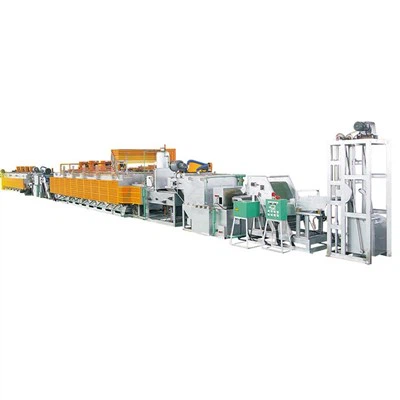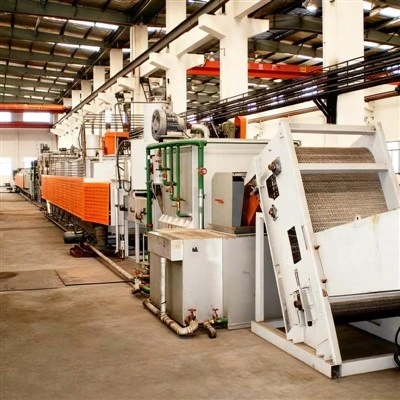
Mesh belt furnace systems are widely used in continuous heat treatment processes, especially for high-volume production of fasteners, bearings, and small metal components. Compared with batch-type furnaces, a continuous mesh belt furnace offers stable throughput, consistent process control, and better production efficiency.
When selecting a mesh belt furnace manufacturer in China, buyers typically evaluate not only equipment pricing, but also continuous operation stability, carburizing process control, furnace atmosphere system, and long-term maintenance cost.
1. CHTEE - Continuous Mesh Belt Furnace Manufacturer
CHTEE focuses on the design and manufacturing of continuous heat treatment furnaces, with core products including continuous mesh belt furnace, mesh belt carburizing furnace, and continuous carburizing quenching furnace. The company operates its
CHTEE focuses on the design and manufacturing of continuous heat treatment furnaces, with core products including continuous mesh belt furnace, mesh belt carburizing furnace, and continuous carburizing quenching furnace. The company operates its own production facility, covering equipment design, fabrication, and commissioning.
In continuous mesh belt furnace applications, CHTEE places emphasis on operational stability under long production cycles, rather than isolated equipment specifications. The furnace design typically integrates conveying stability, temperature uniformity, and atmosphere control to support continuous production environments.
Furnace design and configuration:
- Multi-zone mesh belt furnace structure for heating, carburizing, and diffusion stages
- Continuous mesh belt conveying system adapted to different part sizes and loading conditions
- Controlled atmosphere system for carburizing process stability
- Integrated quenching section for continuous carburizing and quenching processes
Process capability:
- Continuous carburizing process
- Carburizing and quenching
- Tempering after quenching
Typical applications:
- Fastener heat treatment lines
- Bearing and small precision components
- Automotive parts continuous heat treatment
In practical production, a continuous mesh belt furnace is often used to improve consistency across large batches. For example, in fastener production, stable conveying speed and temperature control help reduce variation between different production cycles.
Approach to common operational issues:
In continuous heat treatment environments, several issues frequently occur, such as temperature fluctuation, atmosphere instability, and mesh belt wear. Furnace design is typically optimized to address these factors:
- Temperature uniformity control through multi-zone furnace layout
- Mesh belt lifespan improvement by matching materials and structural design
- Continuous operation stability through optimized drive and tension systems
- Energy consumption control through furnace insulation and structural design
Customization capability:
Different production lines require different mesh belt furnace configurations, depending on throughput, part geometry, and process requirements. CHTEE provides configuration adjustments such as:
- Furnace chamber size and effective heating length
- Mesh belt width and conveying speed
- Number and arrangement of process zones
- Atmosphere system configuration
This approach is more suitable for continuous production lines that require stable operation and repeatable process control, rather than standard off-the-shelf equipment.

2. Aichelin China
Aichelin provides continuous heat treatment systems in China, including mesh belt furnace and roller hearth furnace solutions. The company is often involved in automotive-related production lines.
3. SIMUWU Industrial Furnace
SIMUWU manufactures a range of industrial furnaces, including continuous mesh belt furnace and box-type furnaces, serving small to medium-scale production.
4. Jiangsu Kingkind Industrial Furnace
Kingkind has long-term experience in industrial furnace manufacturing, offering various continuous heat treatment furnace types.
5. Shandong Paijin Intelligent Equipment
Paijin supplies mesh belt furnace and related continuous heat treatment equipment, mainly for standardized production applications.
6. Foshan Huichengsheng Machinery
This manufacturer focuses on hardware processing industries and provides basic mesh belt furnace solutions.
7. Dongguan Jinyuan Furnace Equipment
Jinyuan serves manufacturing companies in South China, with a focus on general-purpose mesh belt furnace equipment.
8. Luoyang Industrial Furnace Manufacturers
Luoyang has a well-established industrial furnace manufacturing base, with several companies offering continuous furnace solutions.
9. Ningbo Hiper Vacuum Technology
Primarily focused on vacuum furnaces, with some involvement in continuous heat treatment equipment.
10. Anhui Xinning Equipment
Provides industrial furnaces and continuous heat treatment systems for various manufacturing sectors.
Common Challenges in Continuous Mesh Belt Furnace Applications
In real production environments, buyers often encounter several challenges when using a continuous mesh belt furnace:
Inconsistent heat treatment results
Temperature variation or unstable atmosphere control can lead to uneven carburizing depth.
Insufficient continuous operation stability
Fluctuations in temperature or conveying speed can affect production rhythm.
Short mesh belt lifespan
High-temperature operation and mechanical load can cause frequent belt replacement if not properly designed.
High energy consumption
Poor insulation or inefficient furnace structure increases long-term operating cost.
Mismatch between equipment and production capacity
Standard furnace configurations may not align with actual throughput requirements.
What to Evaluate in a Mesh Belt Furnace Manufacturer
When selecting a mesh belt furnace supplier, several technical factors should be evaluated:
Continuous operation capability
The furnace should maintain stable performance over long production cycles.
Temperature uniformity
Uniform heat distribution directly affects product quality.
Carburizing atmosphere control
Stable gas composition is critical for consistent carburizing results.
Customization capability
The ability to adapt furnace configuration to specific products and production lines.
Maintenance and service support
Availability of commissioning support and long-term maintenance.
How CHTEE Supports Continuous Heat Treatment Production
In continuous mesh belt furnace applications, equipment performance is closely related to process stability and long-term operation.
CHTEE focuses on practical production requirements in several areas:
Improving process consistency
Stable temperature control and furnace zone design help reduce variation between batches.
Adapting to different product types
Furnace configuration can be adjusted for fasteners, bearings, and similar components.
Optimizing production flow
Conveying system and furnace layout are designed to support continuous operation.
Reducing operating cost
Structural design and material selection help control energy consumption and wear.
Supporting commissioning and startup
Commissioning support helps reduce the time required to reach stable production.
Typical Industries Using Mesh Belt Furnace
Continuous mesh belt furnace systems are used across multiple industries:
- Fastener manufacturing: high-volume carburizing and quenching
- Bearing production: consistent heat treatment for small components
- Automotive parts: stable and repeatable production cycles
- Hardware processing: balance between cost and efficiency
- Different industries require different furnace configurations, making process-based selection essential.
Key Questions Before Purchasing a Mesh Belt Furnace
Before making a purchasing decision, buyers often consider the following:
- Does the manufacturer have relevant application experience?
- Can the furnace be customized for specific production needs?
- Is the equipment suitable for continuous operation?
- What level of commissioning and technical support is provided?
- Can the supplier assist with process optimization?
- These factors directly influence the long-term performance and cost-effectiveness of the equipment.