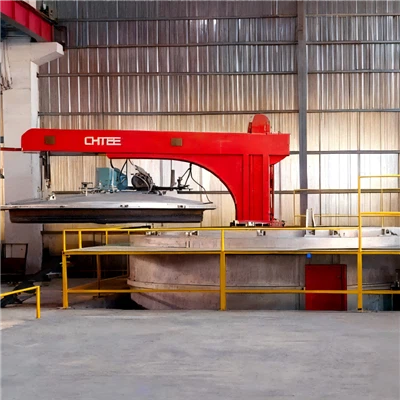
Vacuum quenching furnace systems are widely used in modern heat treatment processes where oxidation control, surface quality, and dimensional stability are critical. Compared with conventional atmosphere furnaces, vacuum heat treatment furnaces provide a cleaner environment.
1. CHTEE - Vacuum Quenching Furnace Manufacturer
CHTEE provides vacuum heat treatment furnace solutions designed for controlled and repeatable thermal processes. Its vacuum quenching furnace systems are developed for applications requiring clean surfaces, stable metallurgical properties, and precise process control.
Unlike continuous furnaces, vacuum quenching systems operate in sealed environments where oxygen content is minimized. CHTEE focuses on integrating vacuum control, heating systems, and cooling structures to maintain consistent process conditions.
System characteristics:
- Suitable for annealing, quenching, soldering, solid solution, and aging treatment of metal parts
- Load capacity adaptable based on production requirements
- Electrical control system equipped with PC-based interface and touchscreen operation
- Integrated heat treatment software for full in-process monitoring
- Fully controlled thermal cycles to reduce process variation
Furnace structure and process design:
- High vacuum chamber for oxidation-free heating
- Uniform heating zone for consistent temperature distribution
- Rapid gas quenching system for controlled cooling rates
- Sealed structure to maintain vacuum stability during operation
Typical applications:
- Tool steels and mold components requiring clean surface finish
- Aerospace parts with strict material property requirements
- Precision mechanical components
- Stainless steel and alloy materials
In practical use, a vacuum quenching furnace is often selected to eliminate oxidation and decarburization. This is particularly important for parts where surface integrity affects performance.
Addressing common production issues:
In vacuum heat treatment processes, several challenges frequently arise:
- Temperature deviation inside the chamber affecting hardness consistency
- Incomplete quenching due to insufficient cooling efficiency
- Surface contamination caused by unstable vacuum levels
- Complex operation without integrated control systems
CHTEE's system design typically focuses on reducing these issues through stable vacuum control, uniform heating, and integrated process monitoring.
Configuration flexibility:
Different applications require different furnace configurations. CHTEE systems can be adapted in terms of:
- Chamber size and usable workspace
- Heating power and temperature range
- Cooling method and gas pressure level
- Control interface and automation level
This allows the equipment to be applied across different industries where vacuum heat treatment is required.

2. SIMUWU Vacuum Furnace
SIMUWU offers vacuum quenching and brazing furnaces for industrial and laboratory applications.
3. Zhengzhou Keda Machinery
Keda provides vacuum furnaces for annealing and quenching processes across industries.
4. Shanghai Gehang Vacuum Technology
Specialized in vacuum heat treatment systems for tooling and precision parts.
5. Shenyang Top New Material Equipment
Focus on advanced material heat treatment equipment.
6. Chengdu AIPU Furnace
Provides industrial vacuum quenching furnace systems.
7. Beijing Huaxiang Furnace Industry
Manufactures vacuum furnaces for multiple heat treatment processes.
8. Dalian Huanyu Furnace Manufacturing
Offers industrial furnace equipment with stable operation performance.
9. Suzhou Chuhan Vacuum Technology
Focus on automation and precision vacuum furnace systems.
10. Hunan Boyun Dongfang
Provides vacuum furnace systems for powder metallurgy applications.
Common Challenges in Vacuum Quenching Furnace Applications
When using a vacuum quenching furnace in production, several challenges are commonly encountered:
Vacuum instability
Leaks or insufficient pumping capacity can affect process quality.
Non-uniform temperature distribution
Uneven heating leads to inconsistent mechanical properties.
Cooling performance limitations
Gas quenching efficiency directly impacts hardness and microstructure.
Complex process control
Manual operation increases the risk of process variation.
High operational cost
Vacuum systems require careful design to balance performance and energy consumption.
What to Evaluate in a Vacuum Furnace Manufacturer
When selecting a vacuum quenching furnace supplier, buyers typically assess the following:
Vacuum system reliability
Stable vacuum level is essential for oxidation-free processing.
Temperature uniformity
Consistent heating improves product quality.
Cooling system performance
Efficient quenching ensures required material properties.
Control system integration
Automated systems reduce human error and improve repeatability.
Customization capability
Different materials and processes require different furnace configurations.
How CHTEE Supports Vacuum Heat Treatment Processes
In vacuum heat treatment applications, system integration plays a key role in achieving stable results.
CHTEE's approach focuses on combining multiple elements into a controlled environment:
Stable process control
Integrated control systems allow monitoring of each stage in the heat treatment cycle.
Flexible process adaptation
Equipment can support multiple processes such as annealing, quenching, and aging treatment.
Improved surface quality
Vacuum environment reduces oxidation and contamination.
Reduced variation between batches
Controlled heating and cooling improve repeatability.
Operational efficiency
User-friendly interface and automated control reduce manual intervention.
Typical Industries Using Vacuum Quenching Furnace
Vacuum quenching furnace systems are used in industries where material quality and surface condition are critical:
- Aerospace components requiring oxidation-free processing
- Tool and die manufacturing
- Automotive precision parts
- Medical devices and stainless steel components
- High-performance alloys and special materials
Each application may require a different vacuum furnace configuration depending on process requirements.
Key Questions Before Purchasing a Vacuum Quenching Furnace
Before selecting a vacuum furnace manufacturer, buyers often consider:
- Does the system meet required vacuum levels?
- Is the cooling system sufficient for the material?
- Can the furnace handle multiple heat treatment processes?
- Is the control system easy to operate and monitor?
- Does the supplier provide commissioning and technical support?
These considerations help ensure that the selected equipment matches both production and quality requirements.