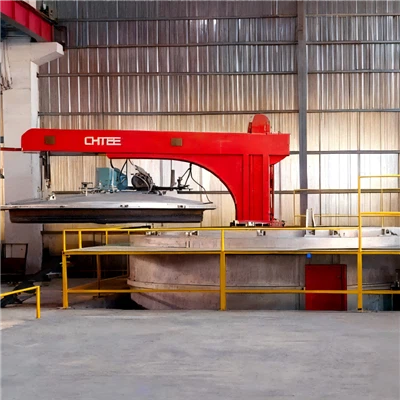
The working principle of atmosphere furnace 320 mainly includes the following aspects:
Atmosphere control: The atmosphere furnace affects the sintering process of the material by controlling the atmosphere in the furnace (such as oxygen, nitrogen, hydrogen, etc.). Different atmospheres will affect the redox reaction of the material. For example, an oxidizing atmosphere is conducive to the oxidation of the metal, while a reducing atmosphere is conducive to the removal of oxides in the material.
Temperature control: The atmosphere furnace is equipped with a precise temperature control system to ensure that the temperature in the furnace is within a certain range to avoid material damage or incomplete sintering due to excessive temperature. Temperature control is essential for the inter-particle bonding and diffusion of the material.
Working process: The working process of the atmosphere furnace usually includes a preheating stage and a sintering stage. In the preheating stage, the temperature in the furnace gradually rises to the target sintering temperature, and an inert gas (such as nitrogen or argon) is usually used to avoid oxidation of the material. In the sintering stage, after the temperature in the furnace reaches the set value, the role of the atmosphere is particularly important, which directly affects the quality of the material and the characteristics of the final product.
Application field: Atmosphere furnaces are widely used in the sintering processing of metals, ceramics, powder metallurgy and other materials. By controlling the atmosphere and temperature, material densification, phase change and performance optimization can be achieved, which is suitable for various industrial fields that require high-temperature processing.