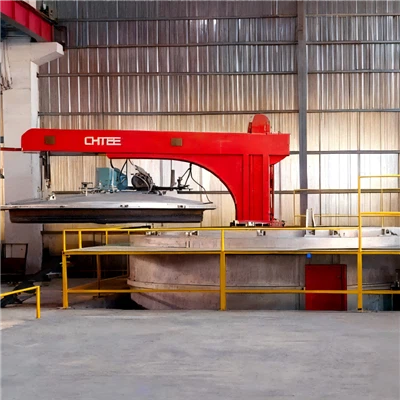
The technical requirements of the quenching furnace mainly include the following aspects:
Temperature control accuracy: The quenching furnace needs to have high-precision temperature control capabilities. For example, the temperature control accuracy of the vacuum quenching furnace can reach ±1℃. This high-precision temperature control can ensure that the workpiece is uniformly heat treated during the quenching process and avoid quality problems caused by temperature fluctuations.
Heating speed: The quenching furnace should have the ability to heat quickly and be able to heat the workpiece to the set temperature in a short time. For example, a quenching furnace using medium-frequency induction heating technology can heat the surface of the steel bar to the set temperature in a short time, reducing heat loss.
Automated operation: The quenching furnace should have an automated operation design, and the entire process from workpiece loading, heating to cooling should be automated to reduce manual intervention, which is suitable for high-intensity continuous production needs.
Structural optimization: The structure of the quenching furnace should be easy to maintain. For example, the modular design of the induction coil can simplify the maintenance process, and the closed-loop cooling system can reduce the risk of scale blockage, extend the equipment's operating life, and reduce the maintenance frequency.
Safety: The quenching furnace needs to pay attention to safe operation and maintenance during use. For example, it is strictly forbidden to work in an environment with flammable or explosive gases, and operators must look after the equipment's operating status to ensure the normal operation of the equipment. In addition, the sensor nozzles of the high-frequency quenching equipment need to be cleaned regularly, and non-professionals are not allowed to adjust the equipment's system and process parameters.