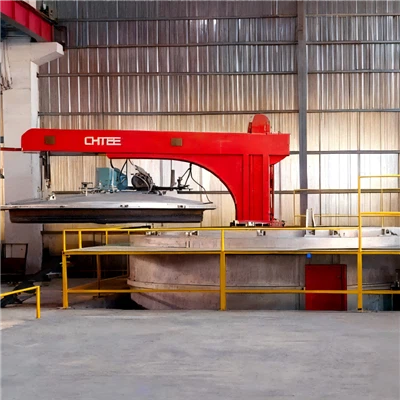
In metal heat treatment production, a well annealing furnace is widely used for processing shafts, bars, wires, and other long components. Its vertical structure makes it suitable for stable heating and large batch production.
In real factory environments, however, many users still face problems such as long cycle times, uneven heating, and rising energy costs. These issues are usually related to operation methods, loading habits, and furnace configuration rather than the furnace itself.
Temperature Uniformity Inside the Furnace Chamber
A stable temperature field is the foundation of efficient annealing furnace operation.
When heat distribution is uneven, operators often extend holding time to ensure full material treatment. This directly increases energy consumption and reduces output efficiency.
In a well type annealing furnace, improving internal heat circulation is especially important. Modern designs-such as those developed by CHTEE-focus on optimizing heating layout and airflow behavior to reduce temperature deviation during long cycles.
Even small improvements in temperature stability can shorten batch processing time.

Reduce Heat Loss Through Furnace Structure Design
Heat loss is one of the main reasons for low efficiency in industrial annealing furnace systems.
Older furnace structures often use thick refractory bricks, which store heat but respond slowly. Newer systems use fiber insulation materials to improve thermal response and reduce unnecessary energy loss.
Key areas that affect heat loss:
- Furnace cover sealing
- Shaft interface leakage
- Insulation layer quality
- Structural thermal bridges
In well-type furnace systems, sealing performance plays a particularly important role during long soaking periods.
Improve Loading Method in Well Annealing Furnace
Loading arrangement has a direct impact on heating efficiency.
In many well annealing furnace operations, baskets are overfilled to maximize output. However, dense loading often blocks heat circulation and slows down temperature penetration.
Better loading practices include:
- Keeping spacing between workpieces
- Avoiding uneven stacking
- Matching load size with furnace capacity
- Ensuring uniform vertical distribution
In most production cases, optimizing loading alone can improve cycle efficiency without any equipment modification.
Gas Control in Spheroidizing annealing furnace Applications
In a Spheroidizing annealing furnace, protective atmosphere control is essential for both efficiency and surface quality.
Common inefficiencies come from excessive gas flow or unstable pressure conditions. This increases operating cost and may still fail to improve surface results.
More efficient operation relies on:
- Stable nitrogen or inert gas flow
- Controlled internal pressure
- Reduced leakage points
- Optimized gas consumption strategy
Modern furnace systems from suppliers like CHTEE typically focus on maintaining stable atmosphere conditions for continuous production environments.
Improve Control System Accuracy
Temperature control systems directly affect furnace efficiency.
Older annealing furnace setups often rely on manual adjustment, which leads to inconsistent heating curves and longer cycle times.
Modern systems use programmable controllers to manage:
- Heating ramps
- Soaking time
- Cooling stages
In vacuum annealing furnace applications, precise control is even more critical because process stability affects material properties and oxidation control.
Better control accuracy reduces overshooting and unnecessary reheating.
Reduce Idle Heat Loss During Production Cycles
Idle time is a hidden source of energy waste.
If the furnace remains at high temperature without continuous loading, energy consumption continues without output.
This is common in small batch production environments.
In well-type furnace systems, improving scheduling efficiency and reducing unnecessary furnace opening time helps maintain stable internal temperature and reduce energy loss.
Match Annealing Furnace Type With Application
Different heat treatment processes require different furnace configurations.
Common selections include:
- Well annealing furnace → shaft parts, long components, batch production
- Vacuum annealing furnace → high-end alloys and oxidation-sensitive materials
- Industrial annealing furnace systems → general heat treatment production lines
Selecting the correct furnace type helps reduce unnecessary energy consumption and improves process efficiency.
CHTEE provides multiple furnace configurations designed for different production requirements in heat treatment applications.
Maintenance of Furnace Components
Long-term efficiency depends heavily on equipment condition.
Key components that affect performance:
- Heating elements
- Insulation layers
- Temperature sensorsGas sealing systems
- Airflow circulation parts
Wear and aging in these components can gradually increase energy consumption without obvious operational changes.
Regular inspection helps maintain stable performance in continuous production environments.