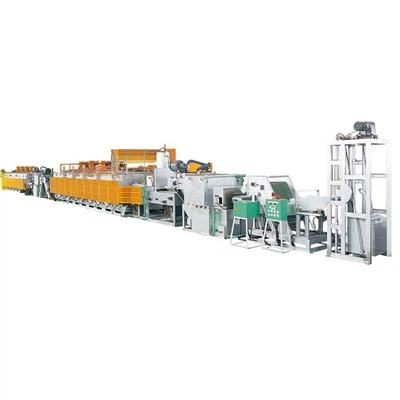

What Is a Belt-Type Quenching Furnace?
A belt-type quenching furnace is a continuous heat treatment equipment designed for large-batch, standardized metal parts (e.g., automotive fasteners, bearing rollers, hardware tools). Unlike batch-type furnaces (e.g., well-type furnaces), it uses a high-temperature resistant mesh belt to transport parts through sequential heating, quenching, and cooling zones-eliminating downtime for loading/unloading and ensuring consistent part quality.
Main Size Parameters
| Model | Total gross output power |
Total length (m) | Quench size (not including the feed table) |
After-heat furnace size (excluding the feed platform) |
|||||
| (KW) | Carburizing | Tempering | Network width |
Net belt heating | Furnace Length |
Network width |
Net belt heating |
Furnace Length |
|
| Length | Length | ||||||||
| TE-QM-E-1 | 220 | 28.5 | 30.5 | 400 | 3.5 | 4 | 600 | 3.5 | 4 |
| TE-QM-E-2 | 400 | 32.5 | 34.5 | 600 | 5.5 | 6 | 800 | 5.5 | 6 |
| TE-QM-E-3 | 450 | 36.5 | 38.5 | 600 | 7.5 | 8 | 800 | 7.5 | 8 |
| TE-QM-E-4 | 550 | 36.5 | 38.5 | 800 | 7.5 | 8 | 1000 | 7.5 | 8 |
| TE-QM-E-5 | 650 | 40.5 | 42.5 | 800 | 9.5 | 10 | 1000 | 9.5 | 10 |
| TE-QM-G-6 | 76000KCAL/1H | 44.5 | 46.5 | 1000 | 11.5 | 12 | 1200 | 11.5 | 12 |
| 100KW | |||||||||
| TE-QM-G-7 | 1250000KCAL/1H | 49 | 57 | 1200 | 12.5 | 13 | 1400 | 12.5 | 13 |
| 110KW | |||||||||
| Note: When the tempering furnace is equipped with the gas blackening process, the length of the furnace body increases by 2 meters. | |||||||||
Product Specifications
| Model | Carburizing monthly output (ton) |
Tempering monthly output (tonnes) |
Carburizing yield per hour (kg) |
Tempering hourly output (kg) |
| TE-QM-E-1 | 58 | 115 | 80 | 160 |
| TE-QM-E-2 | 190 | 270 | 270 | 380 |
| TE-QM-E-3 | 210 | 290 | 300 | 410 |
| TE-QM-E-4 | 340 | 440 | 480 | 620 |
| TE-QM-E-5 | 540 | 610 | 760 | 860 |
| TE-QM-6-G | 670 | 790 | 940 | 1100 |
| TE-QM-7-G | 1000 | 1200 | 1380 | 1600 |
Device construction
1. Energy-Saving Mesh Belt Design
The mesh belt is supported by idlers and designed for superimposed operation in the preheating zone. The heat from the lower mesh belt is transferred to the upper belt and workpieces, effectively saving energy and reducing furnace temperature drop. Additionally, the reduced furnace door opening minimizes raw material gas consumption. The mesh belt drive combines in-furnace idler following with external rolling rollers, ensuring smooth operation without crawling, while roller adjustments allow easy correction of belt deviation.
2. Stable Furnace Zoning and Radiant Heating
Each zone in the furnace is separated by arch bricks at the top, maintaining temperature uniformity and stable atmosphere conditions for reliable heat treatment quality. Centrifugal casting radiant tubes are applied, each zone powered by an independent isolation step-down transformer for safety. The radiant tubes are connected in parallel, allowing replacement without shutting down the furnace, thus ensuring uninterrupted production and long service life.
3. Excellent Sealing and Temperature Control
The furnace structure provides excellent airtightness, with no gas leakage except at the door and oil fume discharge port, reducing fuel consumption and ensuring energy efficiency. Heating elements at the blanking port are carefully arranged to maintain the quenching temperature of workpieces, while an infrared temperature detection port enables real-time inspection of workpiece temperature before oil quenching, improving process control.
4. Efficient Oil Fume Exhaust and Atmosphere Protection
At the rear of the furnace, a micro fan generates a negative pressure difference to exhaust oil fumes beneath the oil curtain. This prevents interference with the furnace atmosphere, reduces carbon black formation, and avoids unnecessary gas waste from direct exhaust. The design ensures both environmental protection and stable furnace conditions.
5. Advanced Quenching and Cleaning System
The quenching oil tank adopts a combined mode of liquid surface jet flow and impeller stirring, ensuring full convection and consistent quenching conditions for uniform workpiece hardness. Supporting cleaning machines are designed with a double-tank structure, additional cleaning nozzles, and extended cleaning time for improved results. For products requiring dephosphorization, the first tank can be filled with dephosphorization liquid to combine cleaning and dephosphorization functions.
Safety device
Temperature Safety Control
Special thermometers and thermocouples are installed on the heating furnace to prevent overheating and to stop dripping at low temperatures, ensuring stable operation and process reliability.
01
Mesh Belt Monitoring and Protection
A rotary detection device with an action detection circuit is used to monitor the operation status of the mesh belt and issue alarms when necessary. In addition, a torque limiter provides safety protection against overload, preventing belt damage.
02
Abnormal Height Alarm
At the front entrance of the heating furnace, a contact sensor detects abnormal transport height of workpieces. When triggered, it issues an alarm and automatically stops the preceding equipment to avoid accidents.
03
Interlock Safety Devices
Various interlock mechanisms are integrated into the system to prevent equipment damage and enhance overall safety during operation.
04
1. Application Scope
The mesh belt furnace is suitable for the heat treatment of various fasteners and other special parts of appropriate size and weight. Its process range includes quenching, tempering (with optional gas DX blackening), carburizing, quenching and tempering, and other related processes.
2. Process Characteristics
Based on the characteristics of this furnace, the thin-layer carburizing process is the most applicable. A carburizing layer of less than 0.30mm is recommended as the most suitable.
3. Process Limitations
It is advised to avoid using the carbonitriding (cyaniding) process as much as possible, since it may shorten the service life of the mesh belt and radiant tubes.
4. Workpiece Considerations
Light, thin plate-shaped workpieces may overlap and adhere during processing, leading to unsatisfactory results or even being "lost." Unless proper preventive measures are taken, such workpieces are not recommended for production in this furnace.
Customized Options and Services
Expandable upon request:
Atmosphere control module (methanol cracking gas/nitrogen protection);
Mesh belt material upgrade (Inconel alloy for high-temperature operation);
Online hardness testing and data traceability system.
A 12-month warranty on core components, a localized spare parts inventory, and process commissioning guidance are provided to ensure rapid commissioning.
As a core equipment for continuous heat treatment, the belt quenching furnace, with its core competitiveness of "batch stabilization + process intelligence," is particularly well-suited for the large-scale production needs of the automotive and machinery industries. It complements pit-type furnaces in both "high-volume continuous processing" and "precision processing of large parts."
👉 Get a Free Custom Quotation (Tell us your part type, material, and capacity needs)
👉 Download Technical Datasheet (Includes dimensions, power, and process parameters)
👉 Schedule a Virtual Demo (See the furnace in action for your specific parts)
Contact us now – Our engineers will design a tailored solution for your production line!
cbx@zjtee.com

FAQ:
1. How does the furnace adapt to varying production demands, and can it integrate with existing production lines?
The furnace's modular design enables flexible capacity adjustment through a stepless speed motor (0.5–5m/min belt speed) and customizable mesh belt widths (450–1000mm). For example, when processing small automotive fasteners, the 500kg/h output can be scaled up to 2000kg/h for larger batches by optimizing belt speed and heating power synchronization . It supports seamless integration with upstream cleaning machines and downstream tempering furnaces via standardized interface protocols, forming an automated "loading-quenching-tempering-unloading" workflow. The water-cooled belt return channel prevents atmosphere leakage, ensuring compatibility with continuous production environments .
2. Can the furnace be customized for specialty materials and how long is the lead time?
Customization capabilities cover:
Material-specific processes: High-temperature models (up to 1000°C) with Inconel alloy belts for heat-resistant alloys, and methanol 裂解 gas/nitrogen protection systems for stainless steel oxidation prevention ;
Atmosphere control: Dual oxygen probes for carburizing processes, ensuring carbon potential stability (±0.05%C) for aerospace components ;
Automation upgrades: Inline hardness testing (Ra≤1.6μm accuracy) and Industry 4.0 data logging integration.
Typical lead time for standard configurations is 8–10 weeks, with custom solutions (e.g., salt bath quenching modules) requiring 12–16 weeks, including factory acceptance testing (FAT) and on-site commissioning.
Hot Tags: belt-type quenching furnace, China belt-type quenching furnace manufacturers, suppliers, factory, Dehydrogenation Furnace, Continuous Bright Carburizing Quenching Furnace, Annealing Heat Treating Equipment, Continuous Mesh Belt Furnaces, Mesh Belt Furnace, Continuous Belt Furnaces