


Heat Treatment for Steel Gear Components
Gears transmit torque through repeated tooth contact. Their heat-treatment requirements depend on the steel grade, tooth geometry, operating load, and specified hardness.
✅ Carburizing: For suitable low-carbon alloy steels, carburizing increases surface carbon content before quenching to develop a hardened case.
✅ Quenching: Rapid cooling develops the required hardened microstructure according to the material and process conditions.
✅ Tempering: A subsequent tempering stage adjusts hardness and toughness while helping reduce residual stresses.
✅ Quality verification: Surface hardness, effective case depth, and dimensional accuracy can be checked against the component drawing and applicable specifications.
Not every gear requires carburizing. The appropriate process must be selected for the actual material and performance requirements.
Mesh Belt Furnace for Continuous Gear Production
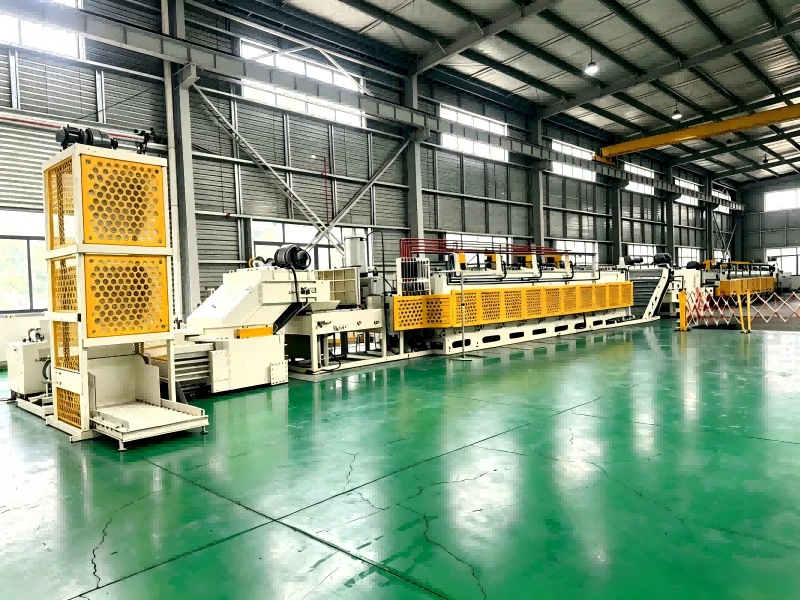
The mesh belt system moves compatible gear components through successive treatment stages at a controlled speed. This layout supports continuous processing and reduces the need for separate batch loading between furnace cycles.
✅ Continuous conveying: Maintains a steady material flow through the production line.
✅ Controlled heating zones: Allow the thermal profile to be matched to the selected treatment process.
✅ Quenching and tempering integration: Supports a connected production sequence where the configuration includes these stages.
✅ Repeatable operating conditions: Stable loading, belt speed, and process settings help control variation between production runs.
Actual output and treatment consistency depend on gear geometry, loading density, furnace configuration, and process validation.
Gear Types and Industrial Applications
A mesh belt quenching furnace may be suitable for compatible small and medium-sized steel components used in:
✅ Automotive transmission gears: Gear components requiring controlled surface properties for repeated tooth contact.
✅ Industrial gearbox gears: Suitable steel gears used in power transmission equipment.
✅ Small drive gears: Components used in mechanical drives and compact transmission assemblies.
✅ Gear-related hardware: Pins, bushings, and other compatible steel parts processed on the same production line when their treatment requirements match.
Part dimensions, loading stability, and heat-treatment specifications must be checked before selecting the furnace configuration.
FAQ
1.Which gears can be treated in a mesh belt quenching furnace?
Suitable applications include small automotive transmission gears, industrial gearbox gears, and other steel gears compatible with mesh belt conveying. The material and required treatment determine whether a particular gear is suitable.
2.Does every gear require carburizing and quenching?
No. Some gears require case hardening, while others use different heat-treatment processes. The correct route depends on the steel grade, gear design, loading conditions, and required properties.
3.How is effective case depth controlled?
For carburized gears, case depth depends on factors such as steel composition, carburizing temperature, treatment time, and the subsequent quenching process. Verification should follow the applicable component specification and inspection method.
Hot Tags: mesh belt quenching furnace for gear components, China mesh belt quenching furnace for gear components manufacturers, suppliers, factory, Batch Hearth Furnace, Batch Integral Quench Furnaces, quenching furnace


